

Want A 9.4-Liter Big Block Hemi With 700+ Horsepower? Here's How Much It'll Cost
America is the land of the free and of V8s. While turbocharging is great and all, most of us dream of a large, hunking V8 that sounds glorious, leaves unending skid marks, and offers the thrust of a Saturn V rocket. It doesn't matter if your project build is a truck, a muscle car, or a sedan — all we want is a crate motor to plonk inside the empty engine bay (V10 engines are also cool, like this new Viper 8.0-liter crate engine).
V8 crate motors range from small-block 350 cubic inch models to monstrous 632 cubic inch designs. But size doesn't equate performance — it has to have both to be a proper V8. Thankfully, crate engines offer anywhere from 500 to 2,000+ horsepower. With that said, there are very few V8 options that offer a fine balance of performance, reliability, and affordability.
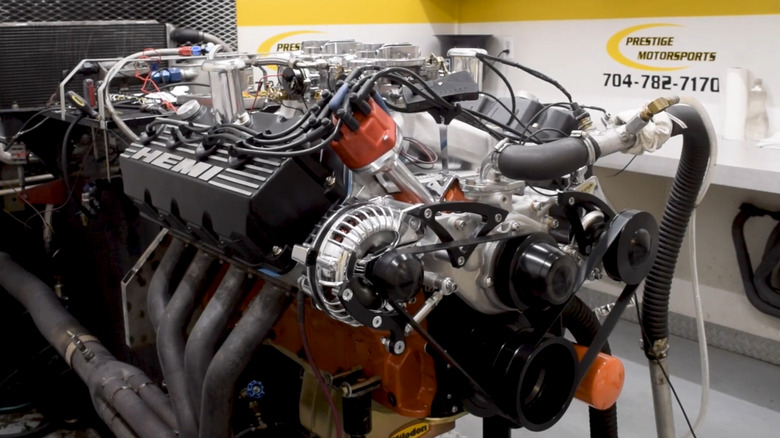
One of these is the 9.4-liter Gen II big-block Hemi crate engine from Prestige Motorsports. The asking price might be a bit steep — around $30,999 — but it brings a lot to the table that justifies the high cost. It's manufactured by Prestige Motorsports, a performance engine builder based out of Concord, North Carolina, that offers engine solutions for restomods, classic muscle cars, pro touring cars, and even powerboats. The company not only provides ready-to-install crate models but also turn-key packages, which also include transmission, cooling, and fuel systems. However, its crown jewel has to be the 9.4-liter Gen II big-block Hemi crate engine.
What's inside the 9.4-liter Hemi?
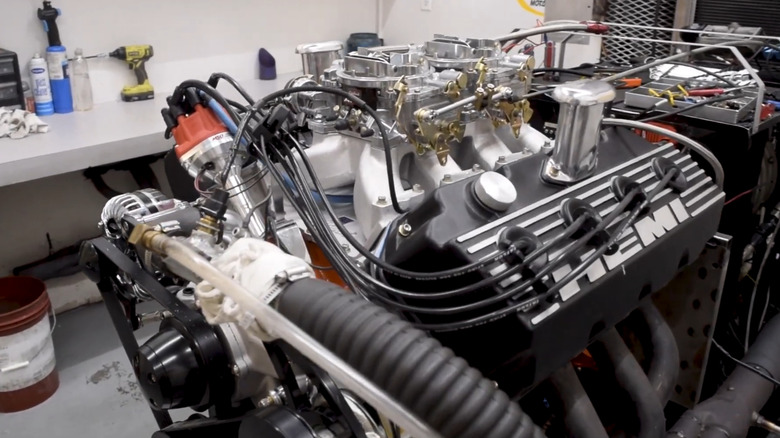
Crate engines also have cool names, like Ford's new Megazilla 2.0. Prestige calls their 9.4-liter Gen II big-block Hemi crate engine the 572 Mopar Big Block Stroker, and it is an amalgamation of parts sourced from the top names in the industry, like Edelbrock, Indy, and MSD Ignition. The engine is also derived from an iconic V8 — the 426 Hemi. The motor is available with either an iron or aluminium engine block. The latter is for those wanting to save weight, especially front-end weight that helps improve vehicle dynamics, besides enhancing acceleration. Both engines offer the same 700 horsepower power outputs.
This is a 572 cubic inch square motor with a massive 4.500-inch bore and 4.500-inch stroke. The motor produces 700-plus horsepower and 686 foot-pounds of torque, runs on 91 octane pump gas, and revs up to 6,500 rpm, making it more than a specialized motorsport engine — it's a street-ready motor. Parts like the MSD Pro-Billet aluminium ignition, 4340 forged steel crankshaft, 4340 forged H-beam connecting rods, forged custom pistons, shaft-mounted roller rockers, solid roller camshaft, and dual Edelbrock carburetors retain the old-school look and feel without sacrificing performance. Reliability? Each hand-built motor is dyno-tested and comes with a three-year unlimited mileage warranty. That's crazy for a high-performance, specialized engine.
The performance comes at a price
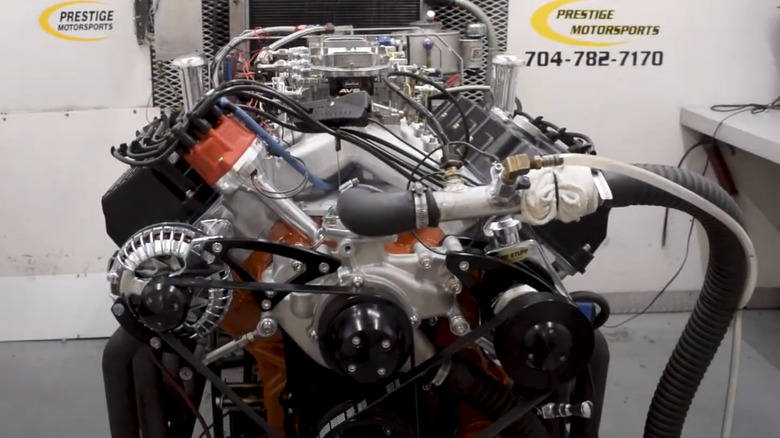
Billet parts ain't cheap, and the 572 Mopar Big Block Stroker is filled to the brim with exotic stuff. It's a built-to-order masterpiece that costs $30,999 a pop. At that price, you'd probably be better off building a project car around the engine than the other way around. Then there are the ancillary costs. A large motor will produce a tremendous amount of heat, so you'll need an upgraded cooling system, as the exhaust needs to be able to expel the large amount of spent gases efficiently. You can't just use any transmission, driveshaft, differential, or axles either because they need to be able to withstand the twisting forces delivered from the motor. The same goes for the suspension components — these need to be able to handle the motor's weight and squat under acceleration. Thankfully, we have a beginner's guide should you plan to take on a project car.
The brakes need to be upgraded to handle the extra stress during braking. The chassis needs to be reinforced, while weight distribution needs to be considered, given the massive (and heavy) engine sitting in the front. Basically, what would be considered a non-issue during a project car build would have to be thought of when working with a motor of such high calibre. That means a lot of reinforcements and high-performance parts all around, which cost money and a lot of man-hours. All said, the 572 Mopar is not about practicality or sensibility — it's a statement. It's a piece of American history, amplified.