

Here's What The K In K-Car Means
We've already answered the burning question "What is a kei car?" This time around, we're not looking at Japan's tiny city cars, we're focused on the family of compact vehicles the Chrysler Corporation launched in the early 1980s. (At the time, Chrysler was in the same situation as Ford or Toyota: There was a parent company named for its founder, which owned multiple car brands, and one of those separate brands was also named for the founder.)
Back then, Chrysler, the corporation, was teetering on the brink of bankruptcy for a number of reasons, and desperately needed a way to back on track. The company decided to attack the problem by a familiar route: It created a single platform that could fit beneath multiple cars. This drastically lowered development costs because the expense of engineering the shared parts was likewise shared among the different vehicles. It's called, unsurprisingly, platform engineering, and it remains common today.
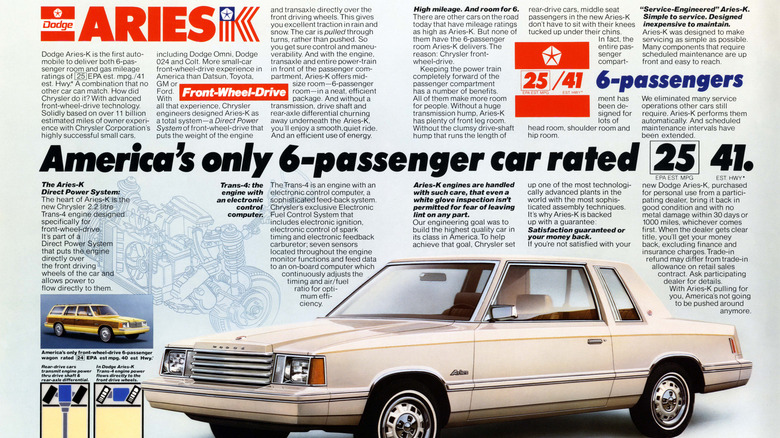
And the K in K-cars simply refers to the internal letter code used to refer to the vehicles' platform. Chrysler did decide to use the letter in its marketing, though, starting with the first magazine ad touting the first K car, the Dodge Aries-K that was "America's only front-wheel-drive 6-passenger car rated 25/41" for city/highway mpg.
The growth of the K-car family
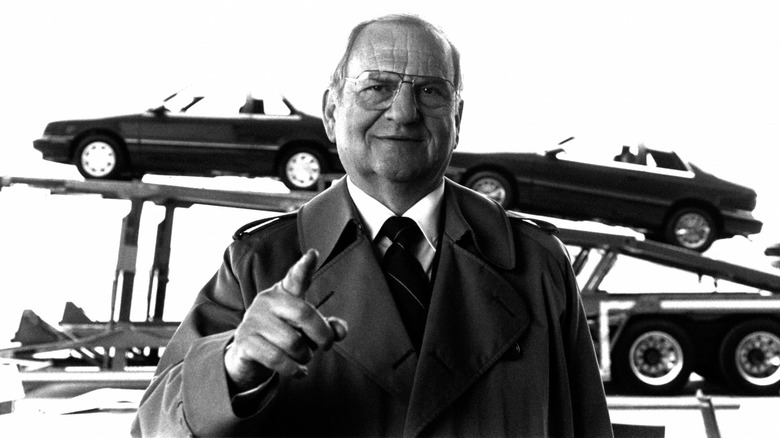
Although he doesn't get much credit, a lot of the success of the K-cars goes to John Riccardo, the Chrysler Group chairman in the late 1970s. When engineer Hal Sperlich came to him saying he could revive the automaker with a new small-car platform, Riccardo gave him the green light. And when Riccardo — who said he was in failing health, though he lived another 36 years — realized Chrysler would need a more dynamic figure to actually transform the cars into a winning play, he stepped away from the company and hired Lee Iacocca.
That said, Chrysler was working on a K-platform before either arrived, trying to leverage the underpinnings from the Dodge Omni/Plymouth Horizon to create a family-sized car. Sperlich seized on the opportunity as a way to both get his own small-car concepts into production and save Chrysler at the same time. Iacocca, for his part, was Iacocca, and would soon be seen haranguing customers to buy more K-cars.
The vehicles launched with the 1981 Dodge Aries and Plymouth Reliant in multiple bodystyles, including sedan, coupe, and station wagon — and customer response was impressive. Chrysler sold some 307,000 K-cars during the first year of production and almost 1.2 million over the first three years. That works out to nearly half of all Chrysler deliveries during the same time. At one point, Chrysler even made a Lamborghini K-car (which never went into production, though).
The king of the K-cars?
From the 1981 Aries and Reliant to the last of the line, the 1995 Dodge Spirit and Plymouth Acclaim, Chrysler built roughly 12.8 million vehicles on the K-car platform and its derivatives — of which there were many. K-car roots can be found in vehicles as varied as the Dodge Daytona sport compact, the Chrysler Executive Limousine, multiple convertibles highlighted by the Chrysler LeBaron Town & Country convertible with its fantastic faux-wood styling.
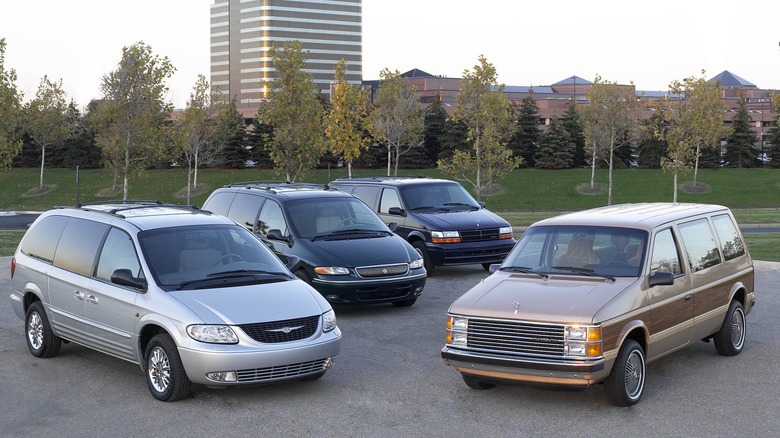
The most notable K-cars, however, didn't just change Chrysler. They changed the auto industry as a whole. Consider: Some of the earliest K-car variants were the 1984 Dodge Caravan and Plymouth Voyager that, with all apologies to the Renault Espace, essentially invented the modern minivan. The concept actually dates back to Iacocca's time at Ford, when he had a chance to see research from another Ford employee — Norm Krandall — who claimed to have discovered an unfilled market segment for a vehicle that would offer van-like versatility with less-than-fullsize dimensions and the ability to carry four to six passengers.
Henry Ford II wasn't much interested, and when Iacocca took over at Chrysler, he took the idea with him. The result, as they say, is history. Minivans and the myth of manliness aside, the first-gen Caravan and Voyager combined for almost 1.6 million sales from 1984 through 1989. And nowadays Stellantis, which currently owns Chrysler, claims its total minivan sales have passed the 15-million mark.