

Time Vs. Mileage: What's More Important For An Oil Change?
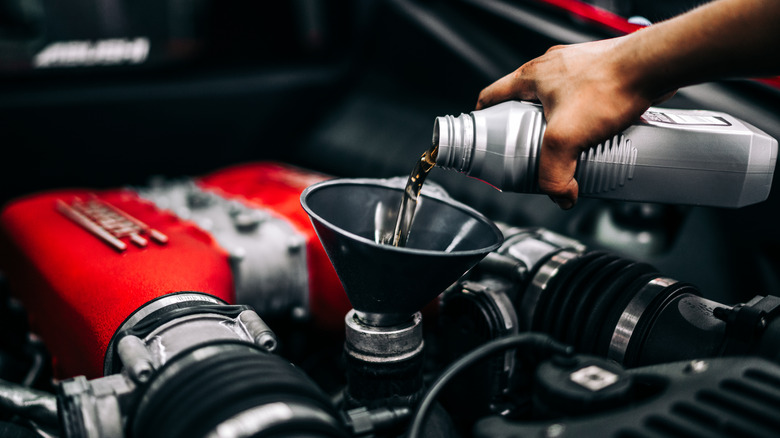
Every time you get your oil changed, the shop slaps a sticker on your windshield. No, not those Faith Hope Love stickers. "Next service: 3,000 miles or 3 months." Most people glance at it once, then completely ignore the part about time. Right? After all, if the car's been parked more than it's been driven, how bad can the oil be?
Turns out, pretty bad. Oil doesn't just wear out from mileage. Oil can go bad just sitting in your engine. Exposure to oxygen causes oxidation; moisture sneaks in from condensation, causing corrosion; and the protective additives inside the oil start breaking down ... all of this even if the car hasn't left the driveway. If you only drive short trips — say, errands around town — the oil may never get hot enough to evaporate that water, which accelerates sludge formation. In some cases, a car with only 2,000 miles in six months can still be "due" for a change because the oil has chemically aged out.
That's why time-based intervals exist. A garage king Chevrolet Corvette Stingray with barely any mileage may still need fresh oil just like the daily-driven Honda Civic. Oil doesn't care if your odometer barely moved. It keeps aging anyway. So yes, months matter, even if your weekend car barely left the garage.
Why mileage still matters
But don't toss out the mileage rule. One of the tasks of oil additives is to suspend and carry away contaminants — unburned fuel, soot, bits of metal — that get produced every time the engine runs. More miles means more junk in the oil, and eventually it can't keep up. That's why manufacturers still build maintenance schedules around mileage, usually with "severe" and "normal" categories.
Here's the kicker: not all miles are equal. Highway cruising puts steady loads on the engine, letting oil last longer. Stop-and-go traffic? Short trips? That's the "severe" side of the spectrum where the same 3,000 miles (or 5,000 miles for modern cars) could leave your oil in worse shape. Idling and low-speed driving use up oil more quickly, even if you don't rack up mileage as fast.
Modern oils complicate the picture. Synthetic blends and full synthetics can last far longer than the old 3,000-mile rule of thumb. Many synthetics are designed for extended intervals, sometimes 5,000 to even 10,000 miles, depending on the car. But again, that assumes "normal" driving conditions, not constant short hops to the grocery store.
So while time plays its part, mileage is still the number one indicator of how much abuse your oil has taken. Ignore it too long, and you'll be left with dirty sludge. That clean up will be much pricey than the cost of an average oil change.
The real answer: Both

Here's where it all comes together: it's not mileage versus time, it's mileage plus time. Oil doesn't ask which you prefer; it wears down in both ways. That's why your owner's manual always phrases oil change intervals as "X miles or X months, whichever comes first." They weren't being coy — they were telling you the truth.
On Bob Is The Oil Guy, you'll find endless debates where enthusiasts post oil analysis reports to prove their personal schedule is the right one. Some stretch intervals based on lab data. Others swear by the 3,000-mile tradition. But the consensus — even among obsessive oil nerds on Reddit and Quora — is that both time and mileage matter, and the "whichever comes first" rule is the most practical answer.
Think of it this way: an oil change is cheap insurance, whether it's gasoline or diesel oil. It's not about lore, it's about science. Neglect either side of the equation and you risk sludge, wear, overheat and in extreme cases, a seized-engine obituary that starts with: "They thought 18 months on the same oil was fine." Following the manufacturer's schedule might feel conservative, but it's how you make sure your car outlives you.