

No Touch Laws: Touching Your Phone While Driving Is Illegal In These US States
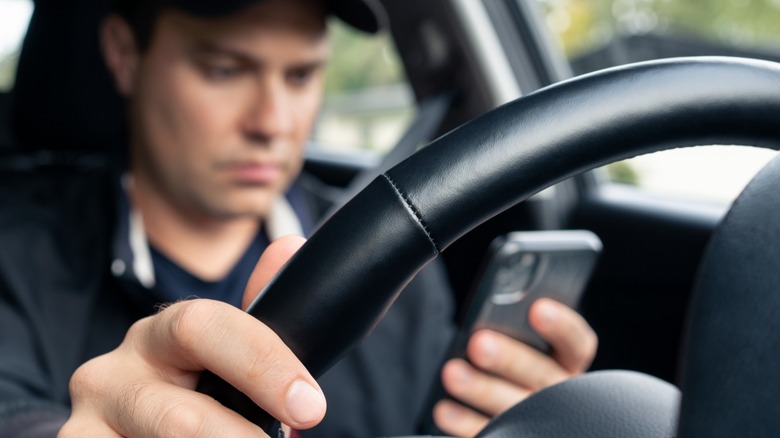
Texting while driving is insane. Reading that tiny text and tapping out cogent responses on that little on-screen keyboard is hard enough. But to believe that you can do that safely while your car is hurtling down the freeway at 60 mph is some kind of delusion. Yet people do it every day. In fact, thousands of people are killed every year in accidents that involve distracted drivers. Hundreds of thousands of people are injured in those kinds of crashes.
A Johns Hopkins study (PDF) found that when drivers use a phone while driving, they are four times more likely to be involved in an accident. That's even if they are using it hands-free. The study also found that using a phone while driving slows down a driver's reaction time by 50%. That is pretty scary, considering that phone use is the most common type of driving distraction.
That's why 49 out of 50 states have a law against texting and driving. But 31 states take it further than that by prohibiting nearly all phone use that isn't hands-free. Those states include Arizona, California, New York, Tennessee, West Virginia, and Pennsylvania. In all but two of those 31 states, the cops don't need another reason to pull you over in order to give you a ticket for distracted driving. If they see you using your phone while behind the wheel, they can initiate a traffic stop. Some states are stricter than others when it comes to fines or points from a texting and driving ticket, but there can be serious ramifications if you're found to be at fault for a fatal accident due to distracted driving. Pennsylvania, for example, may send you to prison for five years.
States where it is illegal to touch your phone while driving
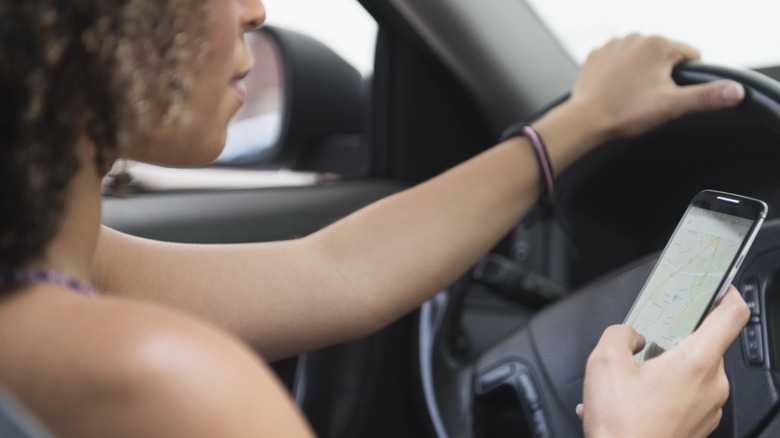
Nearly every state in the union has some sort of law against texting while driving. But 31 states and the District of Columbia make it illegal to handle your phone while driving, except for making 911 emergency calls. Holding your phone at all while driving in most of these states can get you pulled over. This could present a challenge, since reliance on Google Maps and Apple Maps has made some of us so bad at directions that we have trouble getting to the grocery store without their guidance. But there are some exceptions to most of these laws. For example, you can use your maps app, as long as your phone is mounted and you use your hands-free features. Even handling phone calls and other tasks on your phone is usually legal as long as the phone is mounted, and you don't use your hands.
The states that outlaw holding your phone while driving are: Alabama, Arizona, California, Colorado, Connecticut, Delaware, District of Columbia, Georgia, Hawaii, Idaho, Illinois, Indiana, Iowa, Maine, Maryland, Massachusetts, Michigan, Minnesota, Missouri, Nevada, New Hampshire, New Jersey, New York, Ohio, Oregon, Rhode Island, Tennessee, Vermont, Virginia, Washington, West Virginia, and Pennsylvania. We should note that Ohio will allow you to hold the phone to your ear, but not in front of you.
Operating your phone while driving is a primary offense in all of those states except for Alabama and Missouri, meaning the police don't need any reason to pull you over. Fines range anywhere from $50 to $500, and distracted driving can land you in jail if you cause a fatal accident. Penalties are sometimes stricter for young drivers, for bus drivers, and in school zones.
States where it is sometimes illegal to touch your phone while driving
What's up with the other states? Don't they care whether your eyes are glued to your phone while you're supposed to be paying attention to the road? While the other 19 states don't go so far as to ban all handheld use of phones by all drivers, every state except for Montana outlaws texting and sometimes other phone use in certain situations (What's the deal, Montana?).
For example, Texas specifically outlaws texting while driving, and for any driver under 18 to use their phone at all while driving. It's also illegal there to use your phone while driving through a school zone. Texas had a bill that would have had the state join the 31 others in outright banning handheld phone use while driving. However, TX SB47 died in committee earlier this year. However, the state's existing restrictions are still in effect. Likewise, phone use is illegal for minors in Arkansas, as well as anyone driving through a construction or school zone. Similar laws are on the books in Wisconsin, Louisiana, South Carolina, Florida, and other states.
And to be fair to Montana, some lawmakers have tried to get bills passed that would outlaw phone use while driving, but all attempts have failed so far. Also, certain towns and localities in Montana, including one reservation, restrict phone use for drivers. But, unlike Montana, some states don't allow their cities and counties to enact laws on phone use that are stricter than the state statutes. Those states include Florida, Iowa, Kentucky, Louisiana, Mississippi, Nevada, Pennsylvania, Oklahoma, Oregon, and South Carolina.
Are the laws working?
So, do these laws work? How effective are they? Well, the numbers speak for themselves. Colorado reported a 19% drop in crashes caused by distracted driving in the first five months after their hands-free law was enacted. Tennessee enacted a similar law in 2019, and since then has seen a 31% drop in distracted driving crashes. There were 47% fewer deaths caused by drivers on their phones in California after its ban was enacted. Georgia experienced a 3.4% reduction in deaths from traffic accidents in the first year after enacting the Hands-Free Georgia Act. And all 62 counties in the state of New York reported fewer personal injury accidents after handheld phone use began to be prohibited there.
These laws have undeniably saved lives. West Virginia, for example, reported over a 23% decrease in fatalities since adopting a hands-free law, Hawaii reported over a 26% decrease, and the District of Columbia reported an astounding 45.5% decrease. A study released in 2021 by the Center for Injury Research and Policy found that hands-free laws prevented 140 driver deaths and 13,900 driver injuries every year from 1999 through 2016.
And drivers seem to be getting the message, as another study (PDF) reported that in California, 40% of drivers said they talk less on the phone after that state's handheld device ban was adopted. It was observed in D.C. that phone use while driving dropped 50%. Texting and handheld phone use while driving dropped by a third in Syracuse, New York, and Connecticut reported a 57% drop. Of course, just enacting this kind of law isn't enough. According to the Governors Highway Safety Association, these laws have to be clearly worded and visibly enforced with penalties and fines. The IIHS has even suggested using traffic cameras to catch distracted drivers.
The cost of distracted driving
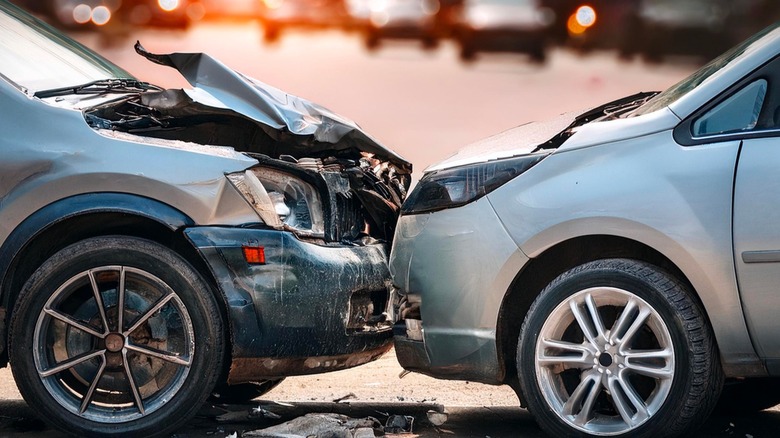
The human cost of distracted driving is both obvious and devastating. There were over 3,200 fatal crashes in the U.S. in 2023 caused by distracted driving, according to the National Highway Traffic Safety Administration (NHTSA). That's nearly nine deadly accidents every day. But the financial cost of distracted driving accidents is also staggering. That's especially true when you consider lost productivity, workplace costs, legal costs, medical costs, insurance costs, and property damage. When it comes to actual dollar figures that include these factors, the most recent data released by the NHTSA is from 2019. In that year, it's estimated that distracted driving crashes cost the American public $98 billion. But that doesn't factor in quality-of-life considerations. These considerations include the impact on life quality from serious injury and loss of life. 2019 NHTSA estimates go up to $395 billion when these things are factored in.
Then, of course, there's the impact on your insurance rates if you're cited for texting and driving. In states where insurance companies are allowed to take these tickets into consideration, the average premium increase is around 28%, but can be higher in some states. Your premium can go up 42% in Rhode Island, 44% in Vermont and New Jersey, and 51% in California.
And getting a ticket for distracted driving isn't always cheap, either. Pennsylvania will let you off with a $50 fine, starting in June 2026. But your first phone-related citation in Maryland will put you on the hook for $150. That goes up to $250 for your second offense in two years, and $500 for every offense after that or for using your phone while driving in a school or construction zone. No matter how you look at it, using your phone while driving isn't worth it.
How to avoid getting a ticket for distracted driving
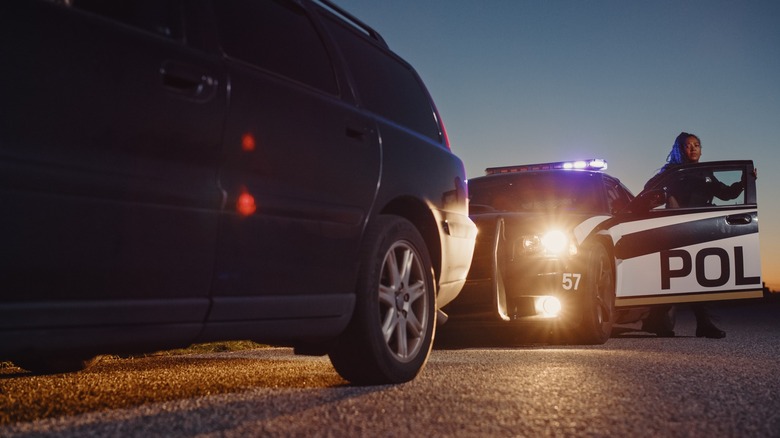
Considering the high cost of fines in some states, no one wants to get pulled over for distracted driving. Of course, the easiest way to avoid that is to put the phone down. Use the hands-free features if you have to make a call or play a song from your Spotify list. Android Auto and Apple CarPlay are options in most newer cars, though they are not completely without risk.
What if you're just using Google Maps? Could you get pulled over for something harmless like that? You can get a ticket for handling your phone for any reason other than emergencies in a hands-free state. And using a GPS app isn't really so "harmless". We've established how much more dangerous the roads are when people are allowed to hold their phone while driving. But do you know which app drivers use the most behind the wheel? That's right, it's their GPS. And, when you think about it, why would it be any less distracting to tap an address into Apple Maps than to type out a brief text? So, pull over before searching for the nearest Burger King or use the voice feature. Don't mute the app just because you want to listen to music. You'll also want to mount the phone in a spot where you don't have to take your eyes off the road.
Make sure to check the laws in your state, too, since they vary from state to state. Some states have stricter restrictions, you may need to know if you're a novice driver. But really, should we need a law to make us drive safely? Wherever you are, keep your eyes on the road and the phone out of your hands.