

What Does The ECT PWR Button Do On A Toyota Tacoma?
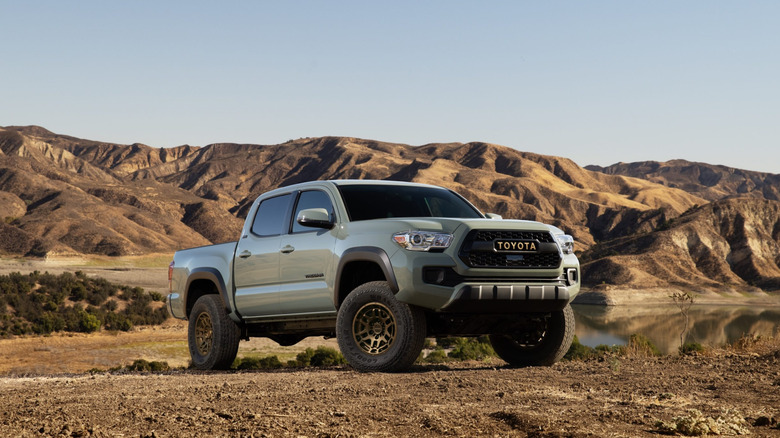
The third-generation Toyota Tacoma was a pretty capable vehicle, especially when configured with its 3.5-liter V6. With that mill making 278 horsepower and 265 pound-feet of torque, a properly equipped 2023 Tacoma, for example, has a max tow rating of 6,800 pounds. (It's also one of the most fuel-efficient pickup trucks with its four-cylinder engine.) But let's say you're in a situation where you need to really get the most out of that output, such as pulling a trailer, heading up into the hills, or accelerating onto an expressway. That's where the ECT PWR button comes into play.
Those letters stand for Electronic Control Transmission Power and refer to a system that's been offered by Toyota since 1981. That was the year it premiered on the Japan-only Toyota Crown Royal Saloon, describing it as the first automatic transmission in the world to be controlled by a micro-computer. It gave drivers the choice of three transmission patterns that were selected by button and included Normal, Eco, and Power settings. The last "places the engine's full power capabilities at the driver's disposal, for driving on mountain roads, for example."
In the third-generation (2016-2023) Tacoma, the ECT PWR button — an actual, physical button, not hidden on a touchscreen — is located just forward of the gear shifter and, oddly enough, placed in between buttons for activating ADAS features. Well, it is a form of driver assistance, since it does help the pilot, and we'll see exactly how it accomplishes this next.
How does the ECT PWR button work on a Toyota Tacoma?
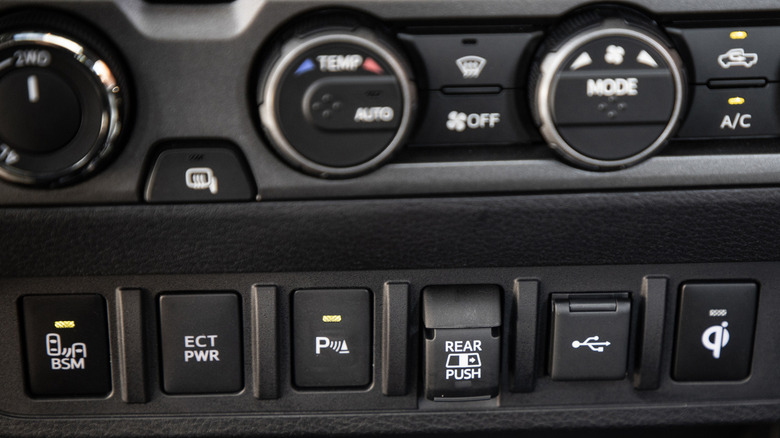
Simply put, engaging ECT PWR tells the transmission computer to let the engine rev a little higher than normal before it shifts up to the next gear. This delivers more power because, generally speaking, an engine kept at the same number of rpm makes more torque with a lower gear than a higher one.
Now, you have to keep in mind that a lower gear actually means a higher ratio. For example, using simple numbers to make things easy, let's say first gear has a ratio of 5:1. In that case, the engine would have to revolve five times to turn the wheels once. For a higher gear, with a lower, 2:1 ratio, the wheels turn once with every two engine revolutions.
Next, assume the transmission normally shifts from first to second when the engine reaches 3,000 rpm, and the ECT PWR button raises that to 3,500 rpm. The result with ECT PWR activated is that the engine can spend more time running at the 5:1 ratio, applying five revolutions for torque per wheel rotation, and less time at the 2:1 ratio, where it only delivers two applications of torque for every wheel rotation.
Note that the third-gen Tacoma was also available with Multi-Terrain Select, offering different modes for off-road performance. Related to, but distinct from, ECT PWR, the Multi-Terrain system adjusts more than just shift points (see below).
Does the 2025 Toyota Tacoma Have ECT PWR?
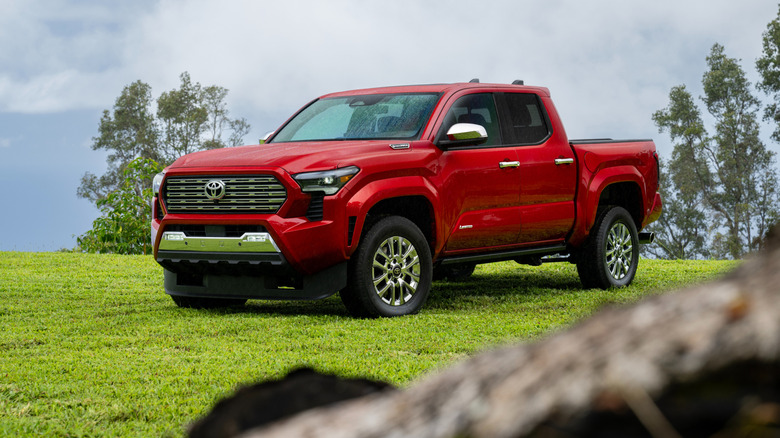
The fourth-generation Toyota Tacoma debuted for the 2024 model year, and the all-new truck offered a significant upgrade in, well, just about everything. For instance, Toyota now offers hybrid power, and the Tacoma Hybrid blows away every truck in its segment. For our purposes, though, let's note that the current Tacoma lineup no longer offers ECT PWR — but it provides two new, complementary technologies to even better meet driver needs.
The first is standard Drive Mode Select with Normal, Eco, and Sport modes. Like Multi-Terrain Select, Drive Mode Select adjusts multiple parameters including pedal response, steering feel, and HVAC settings (to adjust how much engine power is diverted to air conditioning, for instance). Higher-grade Tacoma trim levels expand flexibility by adding Sport S+, Comfort, and Custom settings.
Meanwhile, to optimize the new Tacoma's maximum pulling potential — which, admittedly, declines 300 pounds from 2023 — there's a dedicated tow/haul mode for the also new eight-speed automatic transmission. Like ECT PWR, tow/haul mode lets the engine rev higher before changing to a higher gear, something that's really noticeable on long grades and mountains, per Toyota, plus it helps with engine braking. Just make sure you aren't doing it wrong.