

Why Ford Switched To The Power Stroke Diesel (And Ditched Navistar)
The partnership between Ford and Navistar International was once considered a model collaboration. The celebrated arrangement began in 1982 and saw International Truck and Engine Corporation (later Navistar) agree a deal to supply diesel engines for light-duty Ford trucks. The naturally aspirated 6.9-liter IDI engine introduced in 1983 became International's first attempt to make an oil burner for the Blue Oval. For the 1988 model year, Ford presented a blown version of the International-built indirect injection diesel engine — a 7.3-liter IDI, which was later fitted with a turbocharger as part of upgrades for 1993. This boosted performance, with output rising to 190 horsepower and 388 lb-ft of torque, up from 185 hp and 338 lb-ft in the previous engine.
It wasn't until 1994 that the Power Stroke name was applied to the Navistar-supplied diesel engines, starting with the iconic, direct-injected 7.3-liter Power Stroke turbo diesel. International Navistar followed that effort up with the 6.0 and 6.4 Power Stroke engines before Ford eventually took over production ahead of the 2011 model year. Ford elected to take Power Stroke Production in-house after its relationship with Navistar soured due to reliability problems with the 6.0 engine.
The 6.0 and 6.4 Power Stroke engines suffered a series of issues that led to the dispute between Ford and Navistar
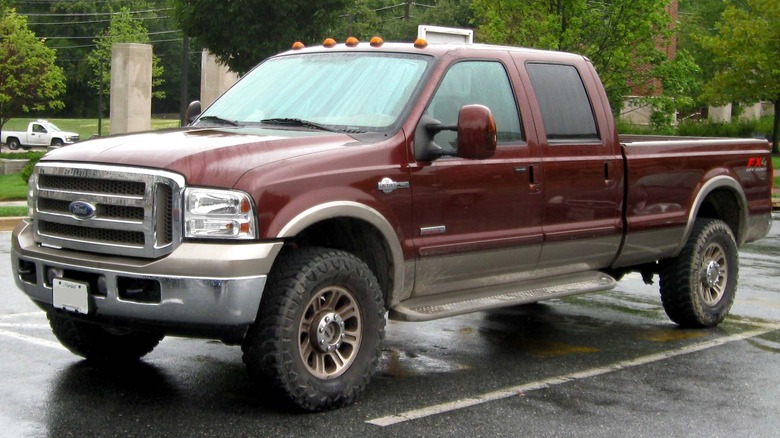
After nine years on sale, production of the venerable 7.3 Power Stroke engine was discontinued in 2003 due in part to increasingly stringent NOx emissions regulations and its inability to meet California noise regulations. In its place, Navistar supplied the 6.0-liter Power Stroke diesel, which was produced through 2007.
The 6.0 was emissions compliant and potent quite alright, generating 325 horsepower and up to 570 lb-ft of torque. But because it was hastily rushed into production ahead of looming emissions standards, the engine encountered some issues, including with its EGR cooler, oil cooler, head bolt, head gasket, and high-pressure oil pump. Some of these problems often led to recalls, frequent repairs, and warranty claims, with Ford understood to have spent around $1 billion in repairs and recalls costs.
In fact, the fault-riddled 6.0 is no stranger to critics even on here, as it was previously voted one of the worst engines by scores of Jalopnik readers. So, it should come as little surprise that it left the scene almost as hurriedly as it arrived, with the 6.4 Power Stroke taking over the reins as the beating heart of Ford's Super Duty pickup trucks from 2008. The 6.4 brought a slight increase in power at 350 hp and 650 lb-ft of torque, and managed to improve reliability overall. However, it had its issues with DPF clogging, pistons cracking, radiator leaking and was further hamstrung by poor fuel economy. But things were already heated before the 6.4 arrived in 2007.
Ford laid bare its grievances in court
When Ford got tired of covering the warranty expenses on its own, it sued Navistar in January 2007 claiming the engine supplier had raised engine prices while refusing to pay its portion of the costs incurred to fix the problematic 6.0 Power Stroke engine. Ford also reduced its payments to Navistar in an effort to recover the money it felt it was being owed for warranty repairs.
In response, Navistar insisted its pricing aligned with the terms of the contract and blamed Ford for failing to fulfill its contractual obligations. It also halted the production and shipment of the 6.4 Power Stroke engines, disrupting Ford's production plans. Later that year, Navistar brought a separate lawsuit claiming the Blue Oval intends to build a 4.4 liter diesel engine for the F-150 itself in either 2009 or 2010. However, the drawn-out saga finally came to an end in January 2009, with the two behemoths reaching an out-of-court settlement to terminate their engine supply contract by year-end.
Ford paid Navistar an undisclosed sum to end the feud and take control of engine manufacturing from 2010. It wasted little time with the introduction of its version of the Power Stroke, the 6.7 Scorpion, which it built from the ground up ahead of the 2011 model year. So far, Ford has manufactured the 6.7 Power Stroke across three generations, with the oil burners now capable of up to 500 horsepower and 1,200 lb-ft. Aside from the few problematic 6.7 Power Stroke years, they are also generally reliable and known to be durable.