

Everything You Should Know About The Corvette Blue Flame Six Engine
The Blue Flame-powered Corvette is an odd chapter from the model's history, and one that some enthusiasts would probably like to ignore, as for decades it wasn't celebrated in the way that it is today. However, the inline-six is very much of paramount importance to the Corvette's creation story. Not to mention, how the Corvette has evolved over the last 60 years, so therefore cannot simply be brushed aside.
Despite only being offered for a few short years, there is an awful lot to learn about the Blue Flame Corvette if you truly want to know everything, and so we've tried to condense as much of it as we can here. From unique tweaks required to turn the inline-six into a true sports car engine, to values today, performance specs of the engine, and why it was ultimately made redundant. This piece explores the creation, production, and demise of the now incredibly sought after and respected Blue Flame engine-powered C1 Corvettes.
Here's why Chevrolet used an inline-six in the first place
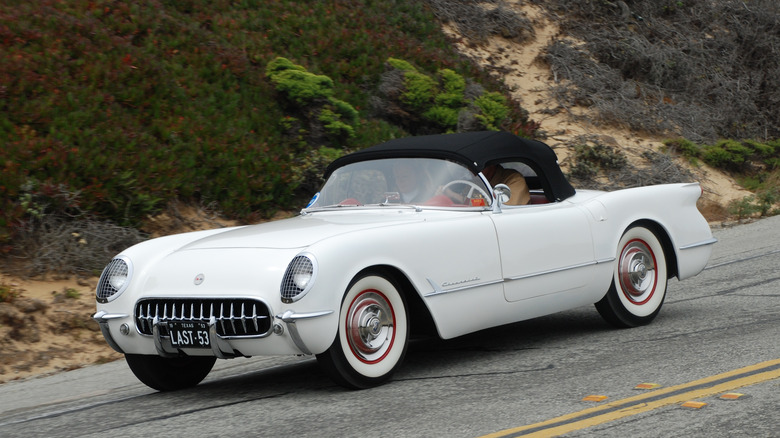
It might seem strange to think that Chevrolet launched the Corvette with an inline-six, when a V8 model would follow so soon after. However, revisiting the timeline, it does make sense. For starters, the Motorama Corvette displayed in 1953 had garnered so much excitement from the public that it was considered better to launch the car immediately rather than wait for a V8 to be developed. Plus, at the time, the Jaguar XK120 was the fastest street-legal car to be had anywhere in the world, and that sported a hot six too. So why would Chevy figure they had to re-invent the wheel — surely an inline-six would be just as successful in its creation too?
Many other popular sports cars at the time were still making do with just four cylinders, as seen with the MGA, and Triumph's TR2. A six-cylinder engine wasn't just a 'make-do' option for Chevrolet, it was the favored choice for sports cars at the time. Pairing this with a lightweight fiberglass body would have provided the Corvette with enough performance to take on the very best. So there really would have been no reason as to why Chevrolet would have turned away from this option for its sparkling new sports car in the early '50s.
The Blue Flame was the only engine option in '53 Corvettes
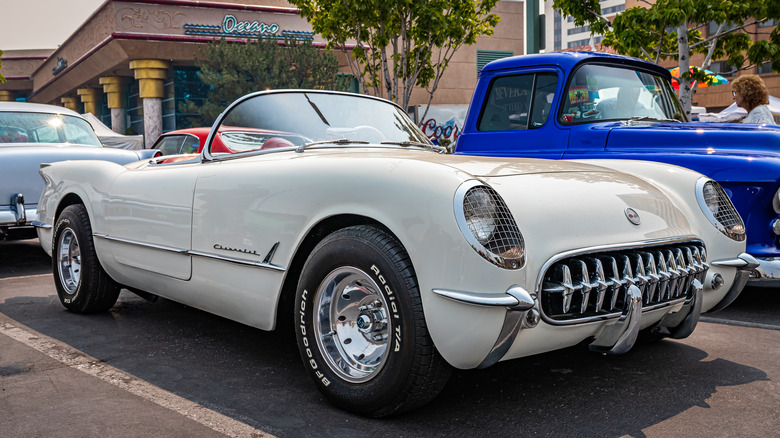
Upon launch, the Blue Flame would stand out as the only option available to buyers of all-new Chevy Corvettes in 1953, paired with a smooth two-speed Powerglide automatic transmission. It was powerful, modern, and the thing looked cooler than anything else in showrooms at the time. Things progressed quickly for America's glistening new star, though, as the arrival of a small-block V8 upset the Blue Flame apple cart somewhat for the 1955 model year.
The V8 didn't immediately replace the lesser-powered Blue Flame, but rather was poised as an option alongside it. Due to the popularity of the more powerful small-block, which powered the majority of the 700 C1s produced for the '55 model year, Chevrolet made the decision to drop the Blue Flame inline-six for the 1956 model. In fact, of those 700, 693 were purchased with the small-block under the hood, so it's safe to assume that this V8 was the firm favorite with buyers of the Corvette.
Chevrolet's already established inline-six formed the basis of the Blue Flame engine
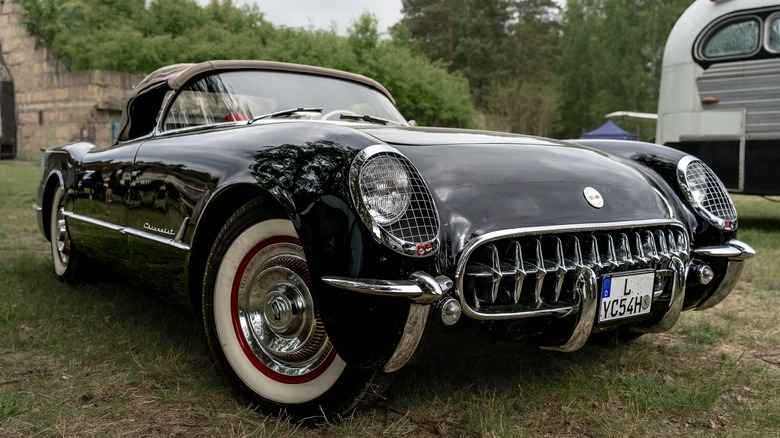
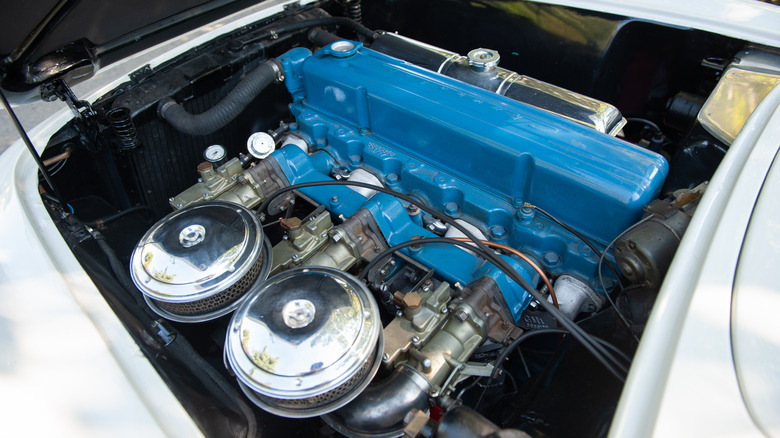
The Corvette's Blue Flame engine was derived from a 235ci engine that was already in use throughout much of Chevrolet's range at the time. Although with an output of just 115 horsepower, some tweaks were needed in order to ensure it was Corvette-ready. For reference, the aforementioned XK120 — which was once the fastest car in the world — was kicking out 160 horsepower at the time, and so Chevy needed to find a fair few horses before they were ready to compete.
Changes to the 235ci engine included aluminum pistons, a higher compression ratio of 8.0:1, a new camshaft, and three horizontally mounted Carter carburetors, which used bullet-shaped air cleaners. Those carbs were mounted to an aluminum intake, and fuel was fed via a mechanical double-action pump. The result? 150 horses — not much by today's standards — but more than enough to do business back in '53.
The Blue Flame quickly became redundant
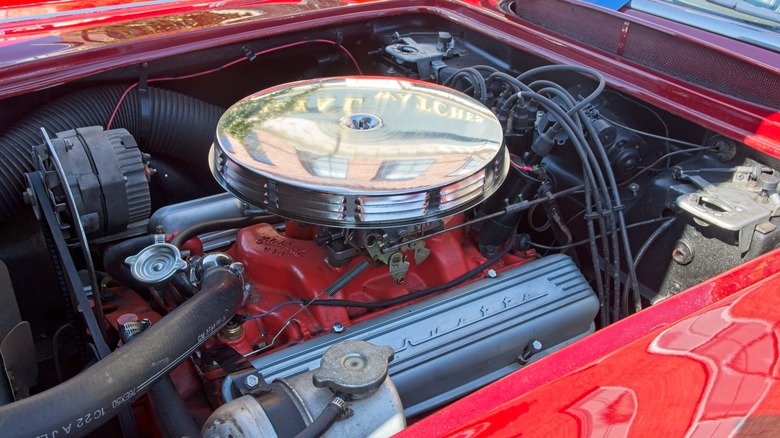
A sleek body, affordable asking price, and a well-developed inline-six engine that could rival the likes of Jaguar — why did the Blue Flame-powered Corvette find itself redundant so quickly? The 265ci small-block V8 introduced in 1954 did the trick, as this proudly boasted a much more exciting output of 195 horsepower — almost a 33% gain above and beyond what the Blue Flame offered.
The introduction of said small-block V8 also saw the introduction of a three-speed manual transmission too. Whereas, the Blue Flame models had only ever been offered with the two-speed Powerglide automatic. The auto wasn't necessarily seen as a bad thing, as automatic transmissions were very much cutting edge and very desired at the time, but it became apparent that driving enthusiasts still enjoyed the option and control of a manual 'box.
With a smaller output and no option to row the gears for yourself, the writing was on the wall for Chevy's Blue Flame really rather quickly. What's more, in hindsight it's clear to see the Corvette was rushed into production, and those early iterations are considered by some to sit alongside the worst sports cars ever made. The fitting of a good ol' fashioned V8 helped to right these wrongs, and the Corvette hasn't looked back since.
No Corvette since has been offered with an inline-six
The Blue Flame engine is an interesting chapter of the Corvette's history, and a unique one too, being the only six-cylinder engine to have ever featured under the hood of one. That's what made the Blue Flame so special. Sure, there have long been rumors that a V6 Corvette may come to the table, and in today's world of electrification and downsizing, perhaps we are only a generation away from a hybridized six cylinder, appearing under the hood.
However, as it currently stands, if you'd like to get behind the wheel of a six-cylinder Corvette, an early C1 is your only choice, and getting hold of one isn't all that easy. Hagerty pegs a good-condition example at $186,000, which is enough to get hold of any C8 Corvette iteration, including the 233-MPH ZR1. However, if it's a show-winner that takes your fancy, prepare to practically double that budget, with Hagerty suggesting a $340,000 budget for such an example.