

This Cooking Oil Powered Engine May Have Been Brilliant, But It Never Found Success
Back in the early days, diesel engines were for trucks, tractors, and stationary applications. They were deemed too heavy, too complicated, and too unrefined to be fitted onto a road car. Well-known names renowned for advancing diesel engine technology and making a once-gigantic, dirty oil-burning machine viable for commercial use include Rudolf Diesel (inventor of the spark plug-less diesel engine), Clessie Cummins, Prosper L'Orange, and Robert Bosch.
However, German engineer and inventor Ludwig Elsbett probably deserves a place in the pantheon of diesel greats. Before working for diesel powerhouse MAN (Maschinenfabrik Augsburg-Nürnberg AG) in 1959, he unveiled single-cylinder diesel engines that didn't have water jackets or cooling fins. By 1973, Elsbett and his team are said to have debuted the world's first mass-produced direct-injection diesel car engine, a precursor to the 1.45-liter three-cylinder Elsbett diesel engine that operated on what the inventor called "duothermal combustion," a process renowned for delivering remarkable efficiency and cleaner emissions.
The "duothermal combustion" diesel engine features an unusual construction, lacking conventional cooling elements such as fans, radiators, and water pumps. Moreover, the Elsbett engine is said to have operated on a diet of diesel fuel or vegetable oil (cooking oil), and to have done so while consuming less fuel than the most fuel-efficient cars of that time.
Duothermal combustion
You would think that having zero external and internal cooling is a bad idea for a diesel engine, but Elsbett thought differently. The Elsbett Museum in Salz, Germany claims that the engine ran smoother and quieter, while still having adequate power and consuming half the fuel — all made possible by what Elsbett called dueothermal (or duothermic) combustion.
Swirled intake air enters the combustion chamber and circulates inside the cylinder. Next, the swirled air moves into the "spherical recesses" of the piston, and fuel gets injected as the piston moves up, with the fuel droplets mixing with the air vortex. High pressure ignites the fuel, creating hot combustion gases.
However, the temperature difference has also created cooler air, now forced between the pistons and cylinder walls, which insulates the pistons, cylinders, and cylinder heads from hot combustion gases using cooler swirled air. The Elsbett engine heats up entirely by radiant heat and friction. And since there are no power-robbing ancillaries like water pumps, all the energy produced during combustion translates to more powah, baby.
The Elsbett duothermal combustion engine wasn't only efficient, the museum says, but also capable of a very long service life owing to its robust construction. Instead of aluminum, it has steel pistons, a steel engine block, and steel cylinder heads. The unified steel construction ensured that all internal components would expand and contract with similar clearances and length ratios.
Moreover, the Elsbett engine has no cylinder head gasket, a component with a reputation for compromising the performance of otherwise good cars. And since the clearances of an Elsbett engine are almost 10 times smaller than those of a standard diesel engine, the museum says, it can run on a diet of cooking oil or vegetable oil without fouling up the combustion chamber with harmful residue.
What happened to the Elsbett engine?
Elsbett and his team installed a three-cylinder, 90-horsepower Elsbett diesel engine into a W201 Mercedes-Benz 190 sedan. They entered the car in the inaugural 1993 Eco Tour of Europe, a cross-European drive of the most fuel-efficient gas and diesel cars organized by the German Automobile Club (ADAC) and the Austrian Automobile, Motorcycle and Touring Club, according to the Elsbett Museum.
The Elsbett Mercedes consumed only 3.76 liters of vegetable oil per 100 kilometers during the event. If it had used diesel, it would have consumed only 3.51 liters, the museum says, beating the Opel Vectra 1.7 TD (3.9 liters/100 km), Renault 19 RT 1.9 TD (4.22 liters/100 km), and Ford Orion LLX (4.25 liters/100 km). But despite winning the eco tour, the Elsbett Mercedes never got the recognition it hoped for.
It repeated its success in 1994, despite the eco tour now getting sponsorship from an oil company. Again, the Elsbett Mercedes beat the competition, the museum says, but the grand prize went to the new VW Golf TDI after judges rejected Elsbett's engine technology. During that period, Elsbett went bankrupt, and he died in 2003 at the ripe age of 89. He was working on an opposed-piston duothermal engine at the time, but never saw what could have been his latest breakthrough and contribution to the diesel industry.
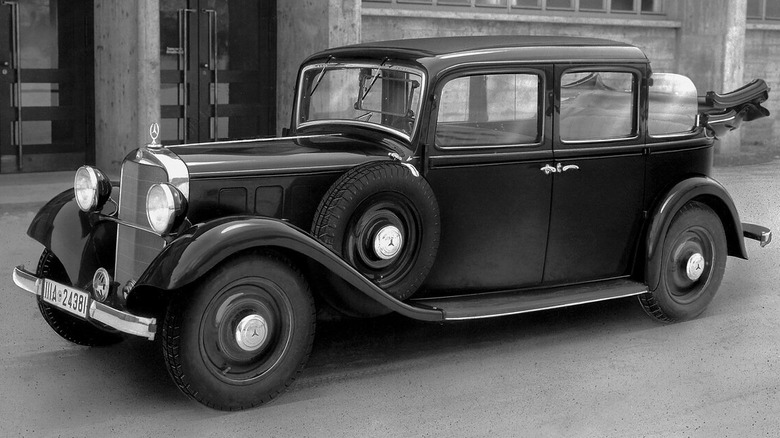
Mercedes-Benz did the unthinkable by launching the 260 D in 1936, the world's first mass-produced diesel car. We could only look back on what could have been if the Elsbett dueothermal diesel engine had ever gained mass-market recognition.