

The Tire Compound Ranges Used In F1: Soft, Medium, And Hard May Not Mean What You Think
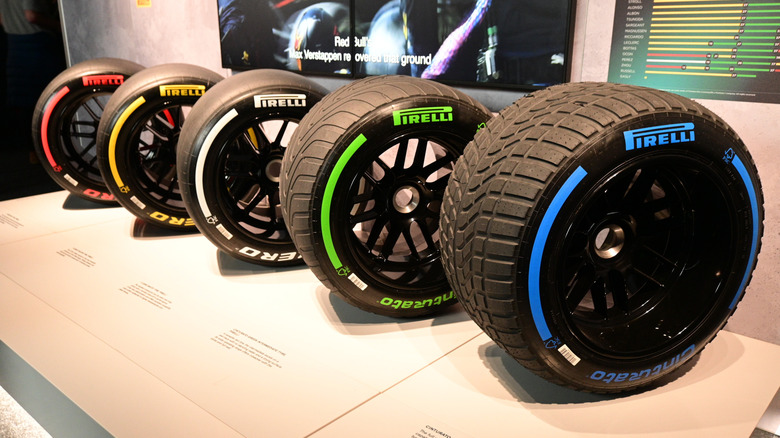
In the high-strung world of Formula 1, some of the most important parts of a multi-million-dollar race car are, without a doubt, the tires. These four small patches of rubber are solely responsible for transmitting all the power, braking, and insane cornering forces to the track. As F1's exclusive supplier, Pirelli has the unenviable job of creating tires that are both tough enough to survive incredible punishment and able to deliberately degrade, forcing teams into the kind of strategic gambles that make for great television. Basically, they're the only part of the car you're actively trying to destroy — just slowly enough to make it interesting.
Pirelli's lineup of color-coded tires — the red Soft, yellow Medium, and white Hard — seems simple enough. But the truth is, those labels are a massive oversimplification. The reality is a complex game of rubber compounds, where a Soft tire at one track can be the Hard tire at the next. This is the key to deciphering the strategic chess match of a Grand Prix weekend, and realizing that what you see on the sidewall doesn't always tell the whole story.
The secret menu of F1 tires
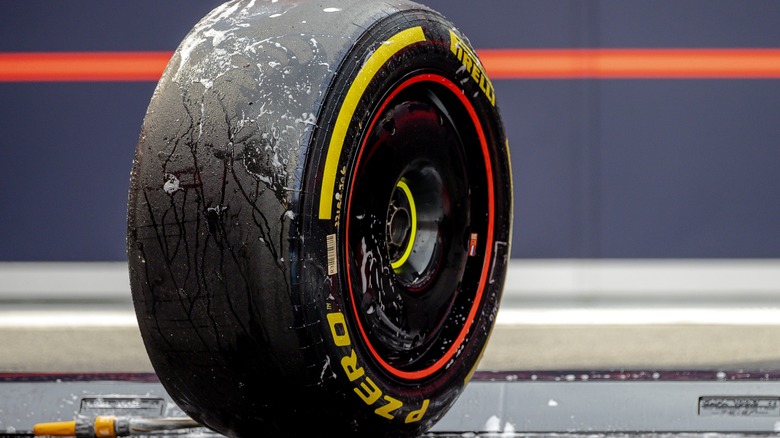
While you'll only ever see three dry tire options on any particular race weekend, Pirelli's actual catalog runs deeper. For 2025, they've expanded their range to six different dry-weather compounds, labeled Compound 1 to C6. Think of the "C" as standing for "Compound," with C1 being the most durable, rock-hard option and C6 being the ultra-sticky option.
This range is a deliberate move by Pirelli to give itself more tools to mess with race strategy. The C1 and C2 are the endurance runners, built for high-speed, high-energy tracks like Silverstone and Suzuka, where tires are tortured. The C3 is the versatile workhorse of the group, the jack-of-all-trades that can play any role depending on the venue. The C4 and C5 are the grippier, faster-wearing options, designed for slower circuits where grip is king.
Then there's the newest sibling, designed with street tracks in mind — the C6, Pirelli's cotton-candy compound that vanishes faster than Nakita Mazepin's career. It's absurdly soft, deliberately fragile, and tailor-made to create more robust strategy options instead of just one-stoppers at places like Monaco. In Pirelli's ongoing war on boring processions, this is the nuclear option: a tire not built to last, but to grip like hell. Fans call it strategy. Critics call it theater. Either way, it lets F1 add fake drama to races when the cars or tracks themselves can't produce exciting racing.
Pirelli's color-coded illusion of choice
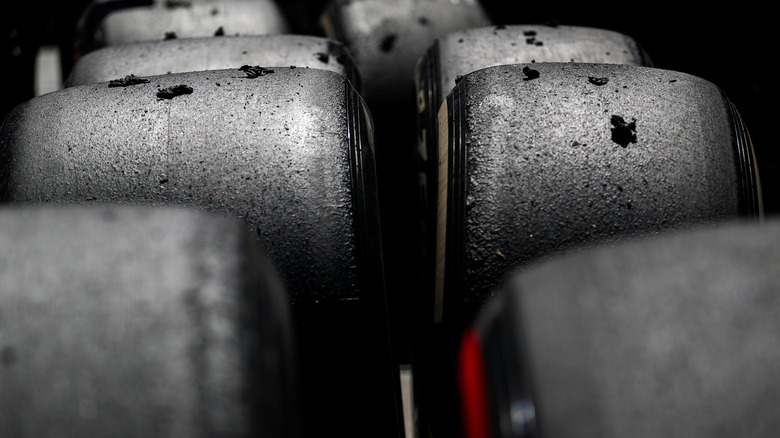
Here's one of the least-known things in F1: the red, yellow, and white sidewalls are just relative labels, not fixed tires. For every race, Pirelli picks three compounds from its C1-C6 range and simply calls the softest one "Soft," the middle one "Medium," and the hardest one "Hard."
The versatile C3 compound is the perfect example of this in action. At a high-energy track like Barcelona, Pirelli brings its hardest tires: the C1, C2, and C3. Here, the C3 is branded as the red-walled Soft tire. But travel to a street circuit like Jeddah, and Pirelli might bring the C3, C4, and C5. Suddenly, that very same C3 compound is now the whitewalled Hard tire, the most durable option available for the weekend.
This is how Pirelli choreographs the chaos, one compound at a time. For the 2025 Belgian Grand Prix at Spa, it's going off-script with a "gapped" compound selection — bringing the C1, C3, and C4 while deliberately skipping the C2. That move creates a massive no-man's-land between the Hard (C1) and Medium (C3), turning the Hard compound into the equivalent of betting on double zero at the roulette table — technically an option, but a risky one. It's not subtle: this is Pirelli steering teams toward aggressive two-stoppers, proving once again that it's not just supplying tires — it's actively shaping the race.
And what happens when it rains?
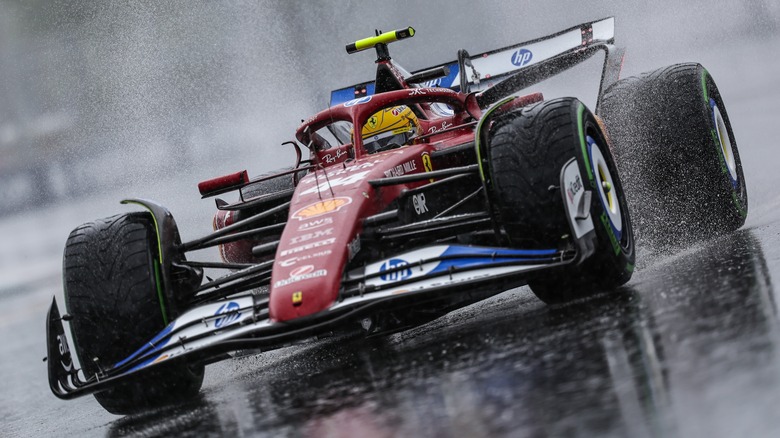
When the heavens open, teams switch to Pirelli's treaded Cinturato tires, which come in two flavors: Intermediate and Full Wet. The green-walled Intermediate is for damp or drying tracks and is an engineering marvel, capable of displacing around 10 gallons of water per second at speed. That means a single F1 car at speed is clearing about 40 gallons of water from all four tires— roughly a full bathtub — every second.
For heavier downpours, there's the blue-walled Full Wet, which can displace a mind-boggling 20 gallons per second. But here's the classic F1 paradox: the Full Wet is so effective at its job that it creates a secondary problem. The massive plume of spray it kicks up completely blinds following drivers, making racing dangerously difficult. It's a perfect example of F1 engineering solving one problem so well that it creates an entirely new one. It's no wonder these Full Wets are surprisingly great for off-roading, as well.