

The Reason Why 160 MPH Might Actually Feel Slow On A Motorcycle
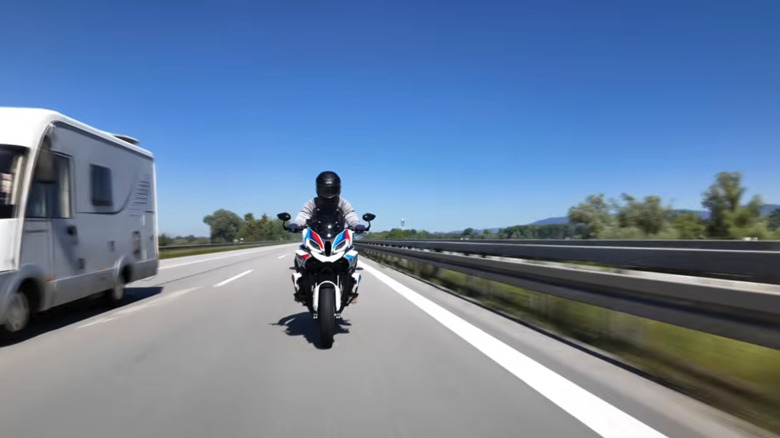
If someone handed you the keys to a 1000-cc motorcycle and set you loose on the Autobahn, you'd hope the experience was exciting, and that wide-open throttle felt fast, instead of slow or boring. For Fortnine's Ryan "F9" Kluftinger, though, it was the latter. My personal experience in another setting supports this claim that doing deep-triple-digit speeds can feel less intense than you'd anticipate. You'd think that on the back of a 200-horsepower-plus, two-wheeled machine, you'd have the thrill of a lifetime at wide open throttle. The science says otherwise, though.
Ryan F9 broke it down in one of his latest YouTube videos, where a trip to Germany and the temporary possession of a BMW M 1000 XR presented a rather perfect opportunity for maximum speed. He took the 200 hp bike to the Autobahn where he could legally put it through its paces and break down the experience in detail.
The sportbike DNA of the XR and its four-cylinder engine can take a rider to a top speed of 170 mph, and Ryan F9 took it to about 160 mph on the unlimited German motorway. The acceleration getting to that speed might have been exciting, but once he was at speed, it wasn't the blissful experience he thought it'd be. He said this was partly due to the open nature of the bike — no peripheral markers like a car's A-pillars around a windshield, along with a lack of large buildings, businesses, etc., would give the illusion that you're not going as fast as the speedometer is indicating. Some of it had to do with his ride height on the bike, too.
Seeing is only part of believing
Acceleration plays a huge part in feeling speed. When an object is not accelerating, or just cruising, the G-force remains almost non-existent, and then you're not feeling the speed. It's part of the reason why drivers easily find themselves accidentally speeding on highways.
It's not the only reason, though. Your brain also depends on markers to help give it a frame of reference for how fast you're going. Donut's video above demonstrated this with a long colorful hallway with white boxes that come at the viewer. The "hallway" moved towards the camera at a consistent speed. Without changing the speed, Donut later slapped a black rectangle in the middle of the frame, which forced the viewer to see just the final movement of the white lines out of frame. It may have seemed like the hallway was moving faster, but it's not — there's just less time to process the movement based on the available visual information. The viewer's field of vision and reference changed.
In Ryan's case, even though the XR was built with similar power and performance to a sport bike, the rider isn't positioned the same way. This particular M-branded BMW had Ryan F9 sitting up tall like he was riding one of the manufacturer's GS models, and that's a very different reference point than you'd get on something like an M 1000 RR.
The closer you are to the ground, the faster things can appear to move because you see more ground in your field of vision. With Ryan F9 sitting further up, his eyeline with the horizon changes — he sees less road underneath him. Combine that with fewer road signs and roadside attractions to pass along the Autobahn, and things feel much slower. He also explains a bit about how the roads on the Autobahn are higher quality than the average Canadian road, and the long travel of the XR's suspension soaks up more bumps than BMW's sportier bikes, so the ride is pretty smooth.
Vantage point
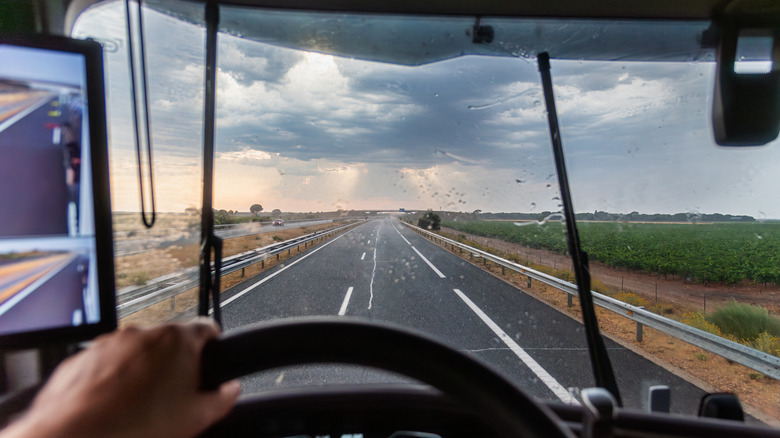
A 2017 study further solidified the correlation between your perspective and speed. Researchers had 30 participants watch 192 recorded driving video clips and were asked to estimate the speeds the vehicles were traveling. Half of those video clips were recorded on wide roads, while the other half were on narrow roads. Participants were more likely to guess quite close to the speed captured when image sizes appeared small, or more narrow. But the larger the frame got, the less accurate the guesstimate was. It's also why you might find yourself going 10 mph over in a larger vehicle more often than you would in a smaller vehicle when you're driving one or the other on long stretches of highway.
Much of this explains the same feelings I've experienced when driving our Ford Ranger, contrasted with the feelings I get when I take to the streets in a colleague's Mazda Autozam. 55 mph felt way different in those vehicles. It's a smooth cruising speed in a tall truck. In a tiny kei car, with the road very close to you, you're basically behind the wheel of a race car.