

The Skyline GT-R Is Arguably Nissan's Most Famous Performance Car, But What Does Its Name Mean?
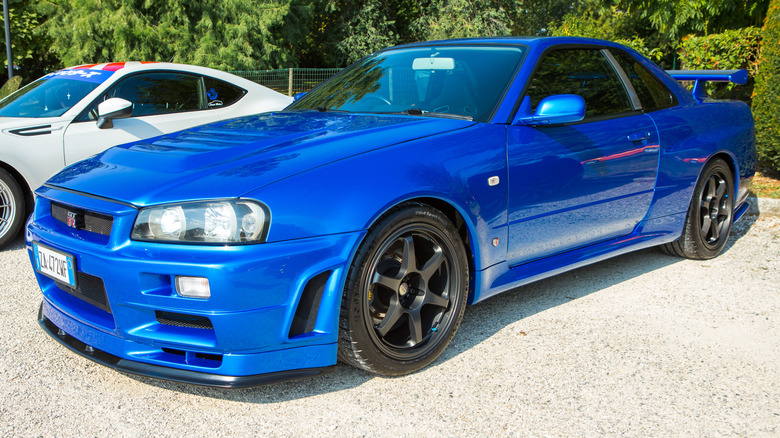
The brilliantly engineered Skyline GT-R is arguably Nissan's greatest hit in the performance car world, with the R32 and R33 Skyline GT-R generations arguably being the most iconic of the lot. That's in part because, while the Skyline GT-R was originally introduced back in 1969, these race-bred versions helped it gain global stardom as the formidable, circuit-dominating legend we've come to know today.
But just what does GT-R mean? If you're familiar with the GT naming schemes, the meaning of GT-R in this case is something you could have guessed: Gran Turismo Racing — "Turismo" being Italian for "touring." The consensus is that Nissan picked an Italian name because it felt more exotic and could help sell the model.
At the heart of Nissan's most famous GT-R models was the famous RB26DETT inline six-cylinder engine, which sent a claimed 276 hp through the brand's ATTESA E-TS all-wheel drive system, itself a seminal feature that varied how much torque was sent to each axle. The combination proved so effective on both road and track that the Skyline GT-R R32 won every single professional race it entered in Japan between 1989-1993 and, in doing so, fully lived up to its famous badge.
The Skyline R32 GT-R made a name for itself outside of Japan too, achieving overwhelming success in a seemingly infinite number of touring car competitive events in Australia. Along the way, it earned the nickname "Godzilla," but the beast wasn't sold for too long, as it was discontinued and replaced with the R33 GT-R ahead of the 1995 model year. The R33 was sold until 1998 before it was itself killed to make way for the R34-generation Skyline GT-R that starred in "Fast & Furious" and was produced until 2002. The R35 GT-R succeeded the R34 in 2007, running until 2025. However, the first Nissan GT-R was something different entirely.
Prince Motor Company laid the groundwork for the first GT-R
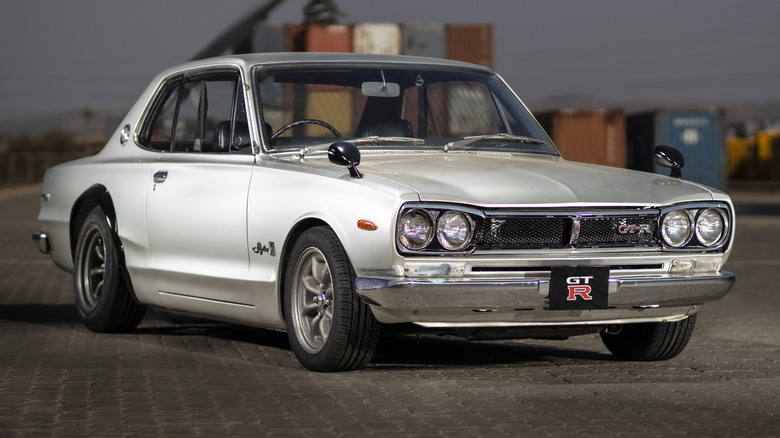
The GT-R name is very much Nissan's, but much of the groundwork for what became the very first GT-R was laid by the Skyline range introduced by Japan's Prince Motor Company in 1957. The first Skylines were nice enough for the time (sedan and wagon versions were available at first), offering a 60-hp 1.5-liter OHV inline four-cylinder engine along with a well-regarded de Dion rear suspension. So, it wasn't until 1963, with the introduction of the 93-hp Prince Skyline Sport Coupe, that the car's sports-focused identity was previewed. A year later, Prince Motor upped its performance ambitions with the release of the S54 Prince Skyline GT — the brand's first "Gran Turismo" — which was conceived to compete in the GT-II class at the second Japan Grand Prix in Suzuka in 1964.
The championship turned out great for the company, as the Skyline GT finished second behind the Porsche 904 Carrera GTS, which, given a big enough straight, could reach a top speed well over 155 mph. Buoyed by this feat, Prince engineers followed up with the R380, which they equipped with a 200-hp, GR-8 2.0-liter DOHC 4-valve mill that was based upon the 2.0-liter G7 inline-six single overhead cam (SOHC) engine that powered the Skyline GT models. With this, the mid-engined Prince R380 earned a landmark win for the brand, scooping a victory at the 3rd Japan Grand Prix in 1966 – the same year the merger deal between Prince Motor Company and Nissan officially completed.
By the time the Skyline sedan finally became a Nissan GT-R in 1969, Nissan drew on the R380's race-bred design, with the GR-8 racing engine that powered the racer forming the basis for the GT-R's 160-hp S20 2.0-liter DOHC inline-6 and justifying the "R" in the car's new name.