

The 'Catcher' Was An Amusing Answer To Reducing Pedestrian Car Deaths In The 1930s: What's Streaming
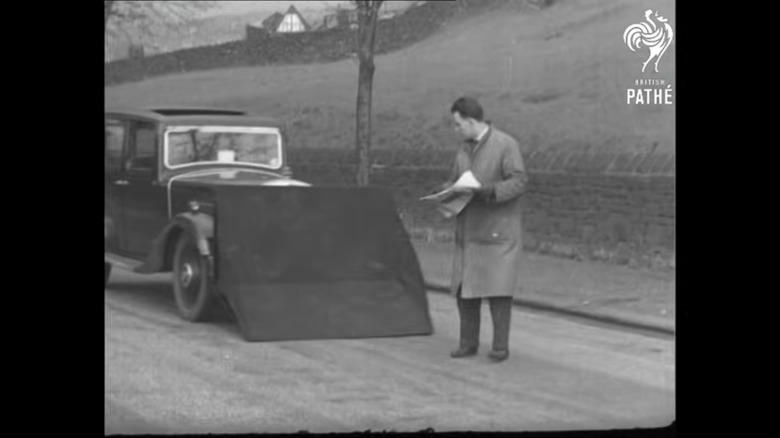
Surviving metal-on-human car crashes has been a daily struggle since cars first took over our streets — for the humans, at least. When it became clear cars would be a financial powerhouse, as well as fun to drive fast, road safety became the responsibility of the person outside of the two-ton death machine. There were folks who cared about human lives just enough to attempts some interesting solutions to the mass death, including patented devices called "pedestrian catchers," like the one featured in this short 1930s film shared by British Pathé.
If you're imagining a pedestrian catcher as some sort of cow-catcher for people, then come up and claim your prize. For this particular device, the "catcher" activated a switch on the steering column to deploy a rudimentary device was made up of two panels and a folded cloth extending on the front end of the car (tire to tire, hood to road). Kind of seems like, if you have time to flick this switch at low speeds, you probably should have time to stop as well, but I digress. The contraption was meant to scoop up a pedestrian and provide a little more cushion for the unlucky walker rather than the blunt force of a metal grille to the side. Realistically, this could have maybe worked for slower speeds (which, again, you could just stop.) Physics might not play as nicely for the faster-moving ones. Obviously, this particular invention from "two engineers in Sheffield," and others like it (yes there are more) didn't exactly catch on.
The lawless, deadly roads of the 1920s and 1930s
As someone with experience driving some of these early vehicles from the turn of the century, they were somewhat unwieldy to drive. To say the steering was unresponsive would be an understatement; most early cars drive like tractors and later ones, in the 20s and 30s, like refrigerators on wheels. Combine that with no kind of standardized drivers' training or rules for the road in general, the streets were a free-for-all, cars versus pedestrians versus also horses and their carriages.
Approximately 200,000 vehicles were on the roads of the U.S. in 1909 according to the Automobile Club of America, and in 1916, that number had multiplied tenfold to 2.25 million as the middle class were more able to afford them. And as car ownership increased, so did pedestrian deaths. The Federal Highway Administration found pedestrian deaths were as high as 15,000 a year in the 1930s, many of them children. For a frame of reference, today, with a larger population and even more cars on the road (and more distractions) the Governors Highway Safety Association reported nearly 7,000 pedestrian deaths in 2025.
The question "how can I have a fast fun cars without all the icky feelings of killing a human being?" continues to haunt the roads until this day. To answer the rising death toll, speed limits and other laws were introduced starting in the early 1910s, but the was no such thing as crash safety for cars. That wouldn't come around until the National Highway Traffic Safety Administration was established in the 1970s. And NHTSA still even today doesn't crash test American cars for pedestrian safety. It was hard to get manufacturers to car about the safety of their customers inside the car, they certainly weren't going to waste time on those on the outside.
With the regulators unwilling to do anything and manufacturers plugging their ears with money, inventors got creative. The earliest example of a pedestrian catcher can be found on film is this 1927 Pedestrian Safety Device demonstrated in Berlin. This particular version of the contraption unfolded into a wide net, scooping the pedestrian to safety.
Catch a pedestrian, if you can
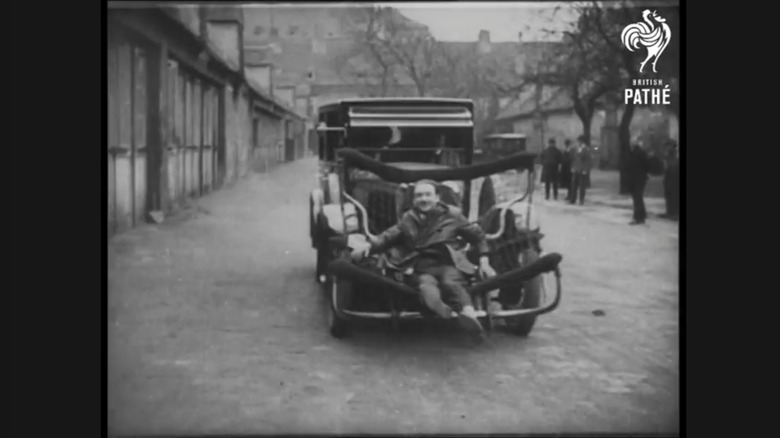
More pedestrian-catching device inventions followed over the next decade in Europe as well as the United States, which can easily be tracked through newspaper stories on filed patents. At some point, writers, finding the devices and their descriptions somewhat ridiculous, turned the devices into more of a joke.
One Springfield Daily Republican reporter in 1931 wrote of a device that scoops up the pedestrian into a chair that then throws metallic arms around the near-crushed human. It's then meant to apply the vehicle's brakes and toss blocks in front of the wheels to stop the vehicle from going any further.
Another tale from a 1936 article in the Asheville Times wrote that another patented device will make "it a pleasure, a joy and a positive delight to be struck by an automobile."
" [...] You are reading a newspaper as you walk along, unconcerned. The car is traveling 40 miles an hour and it can't stop. Sock!
[Its] front bumper hits you! Do you scream, faint, or fall in a puddle of your own blood? not a bit of it thanks to the thoughtfulness of the freres Horowitz. When you get hit by their bumper, things happen, and happen quickly, but not to you.
A softly-upholstered seat rises up as if from nowhere, and catches you on the rebound. You relax in this easy chair and your weight therein sets off a trigger which starts some more machinery moving for your benefit. The trigger pulls a lever, which releases a heavy spring, which puts on the four-wheel brakes.
The car which hit you rolls to an easy halt. You step out of the chair. It collapses into a neat bundle behind the Horowitz bumper. That cocks the trigger, the spring returns to its resting place, the brakes are released, and you thank the motorist who ran into you."
Pedestrian catchers never caught on, and the multiple problems with these devices should be obvious. Deployment was dependent on the driver's quick reaction time and slow speeds, which makes the need for such a catcher superfluous in the first place. When deployed, it reduced the driver's ability to see and inhibited the vehicle's already poor maneuverability. Though if it is deployed, shouldn't the driver should stop driving and help the poor sod they hit.