

What Are Your Rights If You're The Victim Of Bait-And-Switch Pricing Or Hidden Fees?

Have you ever seen a car advertised at a really good price or for a very low monthly payment, just to find out once you arrive at the dealership that the car was "just sold," or the price really isn't available unless you put down a large down payment or finance through the dealership? Numerous car dealerships across the country have engaged in what's called "bait-and-switch" pricing. You go to the dealership thinking you'll be paying one price, but end up paying much more out-the-door. No wonder 76% of Americans think that car dealers are lying about prices.
Is this even legal, though? And what are your rights if the dealership tries a bait-and-switch or tries to add on hidden fees? We asked Gillian Friedman, a Partner at Chudnovsky Law, this and other questions about car fraud. Friedman served as a prosecuting Deputy Attorney General in the California Department of Justice for 22 years. She explains, "Deceptive automobile advertising is prohibited under Section 5 of the FTC Act and state consumer protection laws. Notably, the FTC's 'CARS Rule,' which was intended to ban bait-and-switch pricing and hidden dealer fees, was vacated by the Fifth Circuit in 2025 and formally withdrawn in 2026. As a result, its specific requirements are not currently in effect. However, deceptive pricing practices remain illegal, and in 2026 the FTC warned numerous dealerships that advertised prices must include all mandatory dealer fees." Let's get into what this means for car buyers.
How can I know beforehand that a car might be part of a bait-and-switch scam?
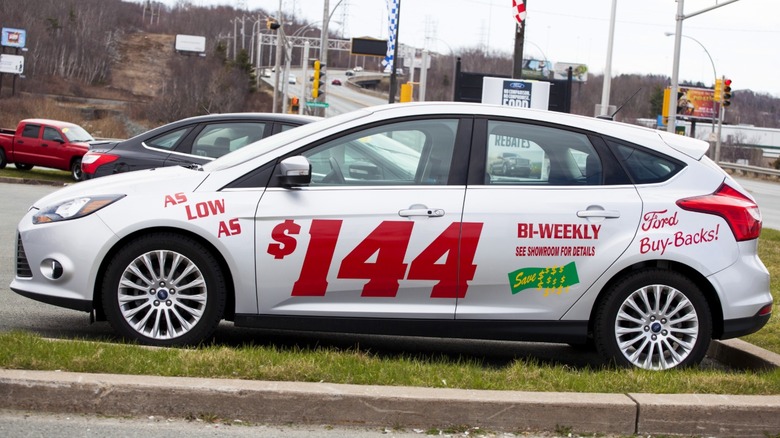
For example, Lindsay Auto Group, a Maryland-based chain of dealerships, was known for advertising low prices for its cars. The prices were so good, in fact, that people would come from all around in search of a good deal. Some even flew in from out of state. The problem, according to the Federal Trade Commission (FTC), is that the prices weren't real. To get those prices, consumers would have to qualify for several rebates that almost no one person could be eligible for. One manager even told a consumer, allegedly, that the advertised prices weren't realistic. Part-owner Michael Lindsay is reported as saying, "We never deliver the vehicle anywhere near the stated price." In fact, consumers would normally pay hundreds and often thousands of dollars more than what the dealer advertised, thanks to fees and add-ons. In 2024, the business was charged by both the state's attorney general and the FTC.
When it comes to actually confirming ahead of time that a car might be part of a bait-and-switch scam, Friedman explains: "Be cautious of prices that appear unusually low, advertisements for vehicles that are suddenly reported as 'just sold,' or pressure to consider a more expensive alternative. Take a screenshot of the advertisement and confirm that the specific vehicle, identified by its VIN, is available before visiting the dealership."
Are dealers required to disclose all hidden fees, and how can I be assured they do?
All the fees dealerships try to add onto the final price of the car can be a problem. One particularly deceptive practice some dealerships have been accused of is called "payment packing." For example, according to the FTC, customers of Asbury Automotive dealerships in Texas would often agree on a total price for a vehicle before signing. The dealership would then get them to agree on a monthly payment, except, unbeknownst to the customer, the payment would be higher than what would have been needed to pay off the agreed-upon price. The dealership would then sneak add-ons and fees onto the total price so that it would match the payment.
Often, these consumers had never agreed to these add-ons and, in some cases, actually turned them down. The result was that consumers were stuck with thousands of dollars in add-ons they didn't even know they were being charged for. To make things worse, the FTC alleges that the Asbury dealerships disproportionately targeted minorities with this practice.
But what does the law say? Are dealers required to disclose all hidden fees? And how can you be sure they disclose all of them? According to Friedman, "Mandatory fees must be disclosed, and concealing them may constitute a deceptive practice under the FTC Act. To protect yourself, request a fully itemized 'out-the-door' price in writing before signing any agreement. The appearance of additional fees only at the time of signing should be considered a warning sign."
Whom should I go to first if I believe I'm a victim?

If you realize that you've been scammed by bait-and-switch pricing, you might be at a loss as to whom to call about it. It seems like it deserves more than just a sternly worded one-star Google review. Yet, it doesn't quite rise to the level of a 911 call, either. So, whom do you go to first if you believe you're a victim of this kind of fraud? The police? A lawyer? The possibly-offending seller? Friedman answers, "Begin by contacting the dealer in writing to establish a record of your complaint. If this approach is unsuccessful, contact your state Attorney General's consumer protection division, your state Department of Motor Vehicles (DMV), and the FTC. If the financial amount involved is significant, consider consulting a consumer attorney. This is not typically a police matter unless there is clear evidence of fraud."
Believe it or not, complaints to government agencies can get results. In 2021, the FTC said that it refunded more than $9.8 million to customers of Napleton dealerships in Illinois for "junk fees" and discriminatory practices. And just this August, the FTC and the state of Connecticut reached a settlement with a Nissan dealer in Manchester for charging unauthorized fees, along with other violations. And we reported on one dealership that had to pay back nearly half a million dollars to its customers because of bait-and-switch tactics a few years back. This year alone, the FTC has sent 97 letters to various dealerships warning them to stop deceptive pricing practices.
What sort of fine print should I look for to determine whether a seller has technically disclosed all pricing (or other necessary) information about the car?

We've all been told to read the fine print before we sign anything, but probably few of us actually do. Dealerships don't always make it easy, either. Customers of the Asbury dealerships in Texas, noted earlier, claimed that they were made to sign their contracts on digital devices that only displayed where to sign, not what they were actually agreeing to. Some dealerships have even been known to expect their customers to sign blank areas of contracts, to be filled in after they get your signature.
What sort of "fine print" should you look for to determine whether a seller has technically disclosed all pricing (or other necessary) information about the car, yet has made it difficult to find or understand? Could a contract have pricing information buried in incredibly tiny typeface in a section you wouldn't anticipate containing pricing information?
Gillian says: "Be alert for pricing presented in very small print, fees concealed in unexpected sections of the contract, mandatory 'add-ons' such as paint protection, dealer preparation, or nitrogen tires presented as unavoidable, and blanks filled in after you have reviewed the document. Do not sign a contract containing empty fields. Terms that are technically disclosed but intentionally obscured may still be considered deceptive."
Does all pertinent pricing information have to be listed in the car's advertising?

Some dealerships have been particularly sneaky when including fine print in ads. For example, according to the FTC, a dealership in Texas advertised two cars in television commercial as available for payments of less than $200 per month in 2016. That sounds like a great deal, except it was only for leases and you would have to put down $1,999 at signing. But the only way a customer would know that is if they were able to catch the fine print that flashed on the screen for just two seconds. A mailer advertised new car payments of $179 per month. But in fine print that literally required a magnifying glass to be seen, the terms were $1,999 as a down payment and $8,271 due at the end of a 38-month loan term!
Does all pertinent pricing information, including the car's cost and financing options, have to be listed in the car's advertising, or will you only be able to find this information once you've contacted the dealer? If the information in an ad is false, who has jurisdiction over this? Friedman says: "Advertised prices must be accurate and not misleading, although not every financing detail needs to appear in the advertisement. False or bait pricing constitutes deceptive advertising. Oversight is generally provided by the FTC at the federal level and by your state Attorney General and Department of Motor Vehicles at the state level."
Yo-yo financing: another way to bait-and-switch

So, Friedman told us about red flags that can tell you beforehand that the dealer may be attempting a bait-and-switch: the price is unusually low, they claim the car was just sold, they pressure you to look at a "better" car, or they won't give you an out-the-door price in writing. We've seen other flags reported by the FTC, such as the dealer wants you to sign digitally without seeing the whole document. But the FTC also warns of at least one way dealers can bait-and-switch you after you've already signed papers and have driven the car home: yo-yo financing.
Sometimes, the dealer will let you take the car home even before your financing has final approval, which is legal. So, you've signed papers, made your down payment, and maybe even traded in your old car to the dealer. You've had the car a few days, have gotten used to it, and showed it off to friends and co-workers — then you get the call. It turns out you were turned down for financing at the rate you agreed on. You'll have to come in and agree to different terms on the loan. Sometimes they'll even falsely claim that you'll lose your down payment or trade in if you cancel the deal. The new terms are always worse, of course. You now have a higher interest rate with higher payments or you'll have to sign for a longer loan. Either way, you're paying more for the car than you agreed on.
How and where to report dealerships you suspect of using bait-and-switch tactics
As Friedman mentioned, you should contact the FTC if you feel you've been defrauded by a bait-and-switch. The way to do that would be through their online form at https://reportfraud.ftc.gov/. It's a fairly intuitive interface and should make reporting simple. One important thing to remember, however, is that the FTC does not resolve individual disputes. It may take your report and other reports to investigate businesses or to bring cases against them.
Other good FTC resources include its consumer hub at consumer.ftc.gov. and its car complaint page on USA.gov. The latter will route you to the correct agency, depending on what type of complaint you have. For example, one of the links it points to under "Deceptive car ads or dealers" is "Your state consumer protection agency." Just select your state from the menu on the next page; you'll be sent straight to the state's website. Similarly, Friedman also explains that you can contact your state's attorney general. A national directory of attorneys general can be found on the National Association of Attorneys General website.
You might also want to check out the auto loans page on the Consumer Financial Protection Bureau (CFPB) website, ConsumerFinance.gov. One of its links allows you to submit a complaint. According to the website, the bureau will work to get a response from the company within 15 days. What sneaky things have you seen car dealers try? Let us know in the comments below.