

Moby Dick-Inspired Slantnose 911 GT2 RS Explains Porsche's Mysterious 'Flachbau' And 'Flachbau RS' Trademarks
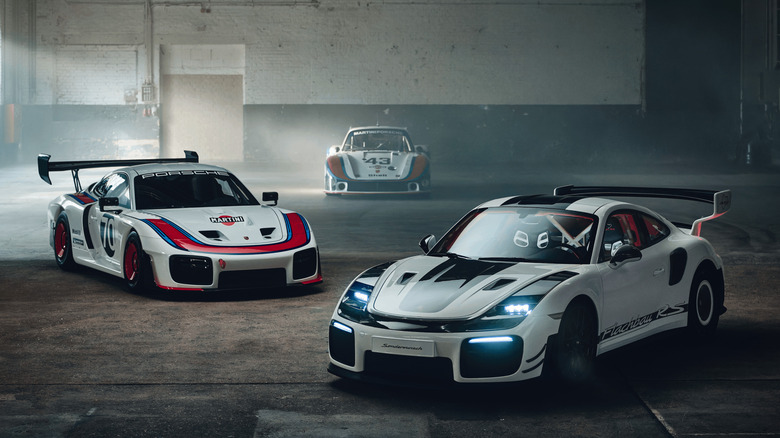
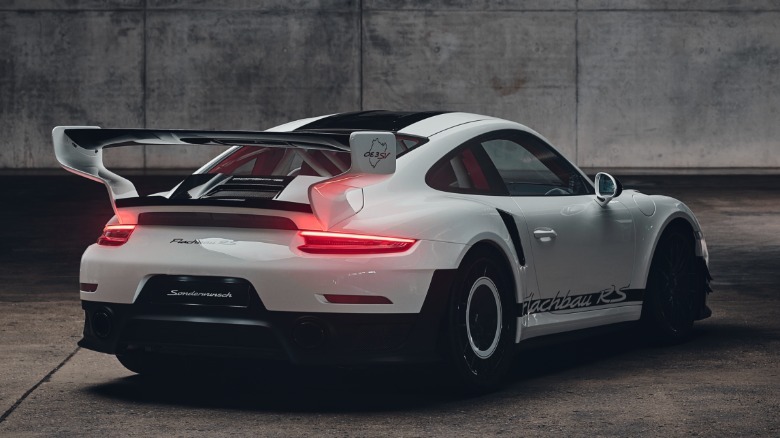
It was hard not to get excited last year when news broke that Porsche had registered the names "Flachbau" and "Flachbau RS" with the European Union Intellectual Property Office. At the time, we didn't know exactly what Porsche planned to do with those names, but maybe the 77-unit slantnose 935 that Porsche brought back (above, on the left) would get a new generation that wasn't quite as limited? Turns out, Porsche had something much rarer in mind. Meet the one-off customer-ordered Flachbau RS that Porsche says exists "in the slipstream of Moby Dick."
In the release, Porsche refers to the car in question as "an extraordinary one-off Flachbau model" and a "road-legal Sonderwunsch project based on a 911 GT2 RS," as well as calling it "a rare one-off Flachbau model," so it doesn't sound like it has a true Porsche-official name. But it got designer Grant Larson to come out of retirement to do one last job, and he refers to it as the Flachbau RS, so that's what we'll go with for now. Not that it really matters when we're talking about a custom-ordered one-off.
And oh, what a one-off it appears to be. Porsche says it started with a 2018-model-year 991.2 911 GT2 RS that had been equipped with the Weissach Package. Once Porsche had the car, it says a "multidisciplinary team of experts from the Sonderwunsch department, Style Porsche, and development engineers from Weissach, Porsche Motorsport and Manthey" spent three years turning it into the Flachbau RS. In the process, they even managed to build something that's a few pounds lighter than it was.
70 pounds of added lightness
As Alexander Fabig, Porsche's VP of product and individualization, said in the release:
Converting the car to a Flachbau model proved to be very challenging, even though we left the powertrain unchanged, in agreement with the customer. Our aim was to reinterpret the iconic look of the 935 without compromising on safety, technology or road legality. Thanks to thorough lightweight measures, this one-off car now weighs almost 70 lbs. less than before. That may sound unspectacular at first, but the 911 GT2 RS with Weissach Package is a sports model that is already uncompromisingly optimized in terms of weight reduction.
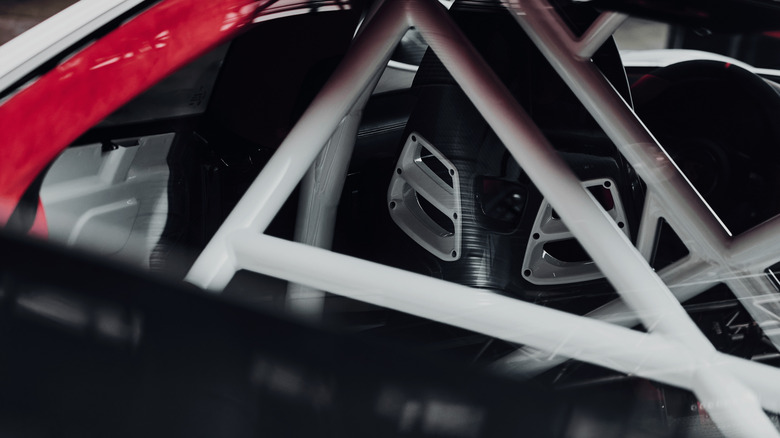
So you're still looking at a stock powertrain, but a 3.8-liter flat-six that makes 700 horsepower at 7,000 rpm and 553 pound-feet of torque from 2,500 rpm is nothing to sneeze at. To get weight out of the car, Porsche says several luxuries had to go, including the Porsche Communication Management system, all audio components, and most of the sound deadening and floor coverings. Some surfaces got trimmed in carbon fiber, but a lot of the metal is just painted Grand Prix White.
 Porsche
To cut weight even further, Porsche says "the newly laid wiring harness has deliberately been left exposed and is covered only by protective sheathing. To reduce weight even more, individual wires that were no longer needed have been removed."
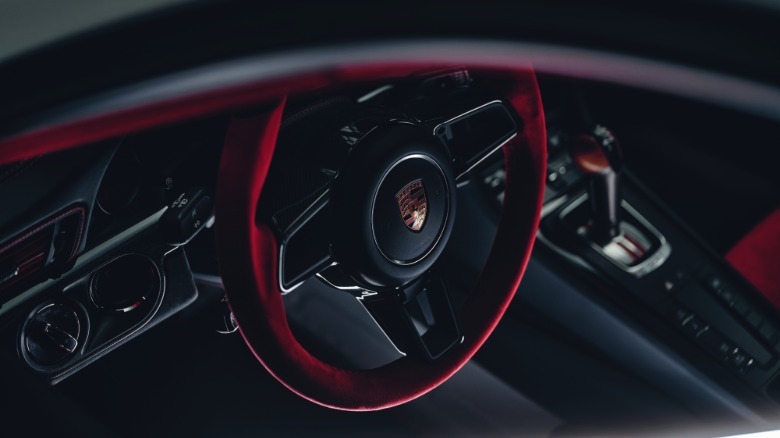
That said, it isn't a completely barebones track build, just barebones compared to modern road cars. The Flachbau RS still has a PDK gearbox, two carbon-fiber bucket seats with Flachbau RS lettering embroidered over an outline of the Nürburgring on the headrests, a commemorative plaque on the passenger side that's been engraved with the inscription "Werksunikat 2026 – Flachbau RS." Heck, even the spot where the PCM used to sit is now trimmed in leather.
Moby Dick 2
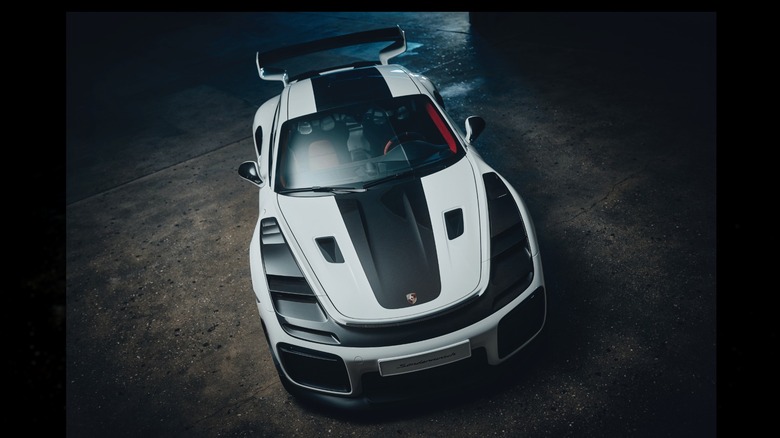
While most custom-ordered cars rarely see the light of day, much less the race track, it sounds like the customer who commissioned the Flachbau RS at least wanted a car that would drive well. As they should, considering they asked for a GT2 RS-based modern Flachbau with paint inspired by the legendary 935/78 Le Mans racer known as Moby Dick. The bodywork's been aero-optimized, the top speed in the "High Downforce" setting is still 211 mph, and at that speed the rear wing is good for 1,221 pounds of downforce at the rear.
That could have all probably been accomplished with design software and virtual testing, but the Flachbau RS's owner went even further, paying Porsche for some serious development work. Sure, Porsche tested the new parts that it developed for the car and performed vibration testing on the wing, but Porsche says the Flachbau RS development went much further than simply making sure the car wouldn't fall apart if it ever got driven hard:
A total of three test vehicles were built to carry out further validation tests in facilities such as lighting and wind tunnels, as well as during real-world road tests. Numerous test drives at the Mendig airfield, 50 laps on the Nürburgring-Nordschleife alone and endurance tests at the Weissach site combined to simulate a load on the rear wing equivalent to about 93,200 miles (150,000 km) of customer use.
 Porsche
"On the Nordschleife, it becomes immediately clear how cleanly the aerodynamic concept works," Porsche test driver Lars Kern said. "The Flachbau RS remains extremely stable and precise even at very high speeds. This is exactly the kind of feedback needed in order to validate such a radically altered body design."
Even when they were new, a 991.2 GT2 RS with the Weissach Package cost a minimum of $325,000 before you account for customization, dealer markup, and all the Porsches you had to buy to get that GT2 RS allocation in the first place. These days, they regularly go for almost seven figures. Throw in all that development work, including three test vehicles, and there's no telling how much it cost to commission the Flachabu RS. Porsche won't say, either, but it was probably more than enough to fund an independent newsroom for an entire year. The car is also homologated for road use in Europe, hopefully so the owner can drive it to the track. Surely they wouldn't pay all that money for a car they intend to stick in climate-controlled storage, right?