

The Renault 5 Turbo Was A Hot Hatch That Could Go Over 800 Miles On One Tank Of Gas
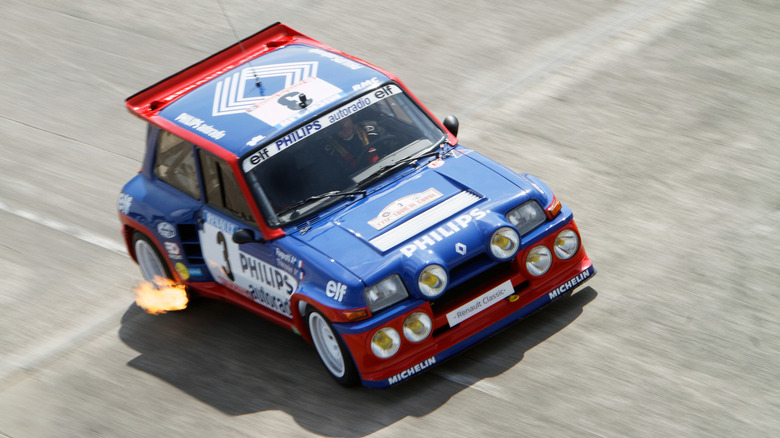
Sitting nine inches wider and three inches lower than the standard R5, the Renault R5 Turbo was never built to look subtle. In fact, this tiny hatch featured a mid-mounted turbo four-cylinder in place of rear seats. Naturally, a car that is aesthetically and functionally as wild as the R5 Turbo would be a homologation special — and, in fact, it was. The R5 Turbo shared its basic body shell with the ordinary Renault 5, but virtually nothing else carried over. Marcello Gandini — the Bertone designer responsible for the Miura and the Lancia Stratos — reshaped the body with massively flared fenders to accommodate wider tires and house the intercooler. The resulting chassis weighed in at 2,138 pounds, heavier than the standard R5 (but still far quicker).
Behind the front seats is a 1.4-liter four-cylinder fed by a Garrett T3 turbocharger with Bosch K-Jetronic fuel injection in place of the standard Weber carburetors. Compression ratio was dropped to 7.0:1 to deal with the boost pressure, allowing for fantastic power delivery that rewarded commitment. Output was about 157 horsepower at 6,000 rpm — making it the fastest French production car at the time.
With rear-wheel drive, four-wheel vented disc brakes, and double wishbone rear suspension, the Renault R5 Turbo was built for competition the standard R5 could never to approach. A 0-62 mph time of 7.7 seconds and a top speed of 126 mph were fighting numbers at the R5 Turbo's size. The road-going Renault R5 turbo was also outfitted with a centrally-mounted, two-section, 93-liter fuel tank. The monster capacity paired with a combined mpg of 25.6 yielded upwards of 600 miles on a single tank. At the right maintained speed and sustained mpg — say, around 33 mpg — the R5 could hypothetically drive more than 800 miles on a full tank.
A headlining fuel capacity and a lasting rally legacy
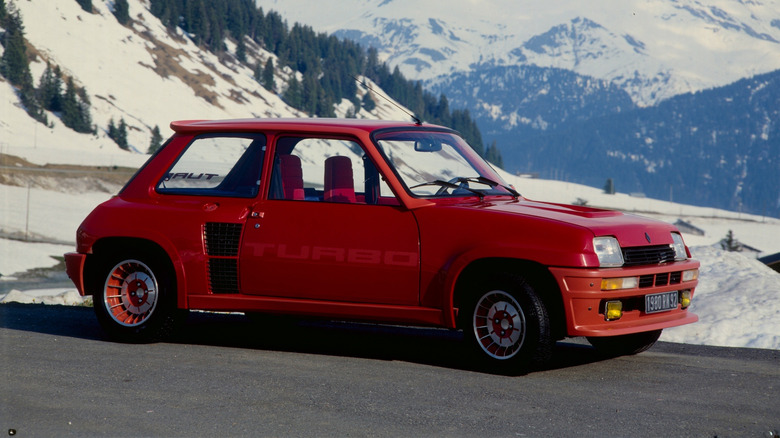
High production costs meant Renault would barely complete the 400 required road models for Group 4 entry. Regardless, the mid-engined R5 quickly grabbed the sports attention with Jean Ragnotti behind the wheel. Ragnotti would take home wins at the 1981 Monte Carlo Rally and the 1982 Tour de Corse — with the latter being part of the inaugural season of Group B rally cars.
The original production run of the R5 Turbo went from 1980 to 1982, resulting in just 1,820 units. The end of 1982 saw the Turbo 2, which used the same engine and layout — this time substituting the aluminum body panels for steel. Along with the added heft, Renault sterilized the cabin to more closely match the regular, front-drive R5. 3,167 Turbo 2 units would be produced through 1986, making the initial batch twice as rare to find.
In 1985, Renault would build a limited run of 200 MAXI 5 Turbos to suit Group B homologation. The final competition spec of the already-provocative Turbo would feature a larger 1.5-liter engine that now produced around 345 horsepower. The lightweight package would greatly benefit from the added power. With the rally field quickly becoming dominated by AWD vehicles, Jean Ragnotti's R5 Turbo took home a Tour de Corse victory in '85 while future WRC champion Carlos Sainz Sr. would finish runner-up in the Spanish Rally Championship that same year. The triumphs of the MAXI 5 would mark the last of the R5 Turbo's competitive statement before the Group B series was cancelled in 1986.