

Helmet Tubes Are Just The Goofy Part Of IndyCar Cooling Systems You Can See
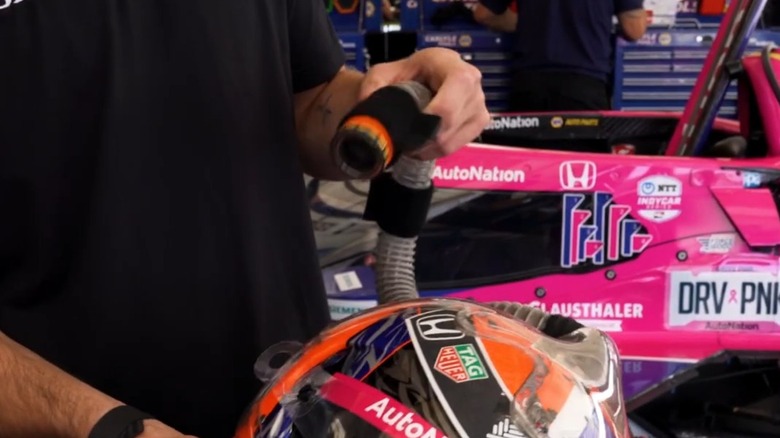
Much of the attention in motorsports is focused on the incredible speeds race cars reach during competition. An IndyCar traveling on an oval track can reach up to 240 mph, which is even faster than F1 cars' top speed. (This is why IndyCar is named "IndyCar," for those unfamiliar with its history and start in Indianapolis.) But while drivers are navigating at these immense speeds, they're also battling intense heat in the cockpit.
For example, Racer reported that one 2020 event at the Indianapolis Motor Speedway saw IndyCar drivers combatting cockpit temperatures in the range of 120 degrees Fahrenheit. After 80 laps, many of the competitors were extra fatigued due to the heat. "The drink bottles are in the sidepods with all of the exhaust, and the water is hotter than I drink my coffee," driver Graham Rahal said. "Overall it was brutal."
As miserable as that sounds, it would be unbearable without cooling systems in the drivers' gear. One of these includes a hose that plugs into an intake on the side of the cockpit and then into a vent on top of the driver's helmet. This setup pushes cooler air into the helmet and onto the driver's head to help keep them comfortable. Admittedly, it looks a bit bizarre until you understand its purpose. But the helmet tube isn't the only thing working to keep drivers cool.
Cooling suits

To better guard against drivers getting overheated during a race, some wear a special kind of clothing with a series of small tubes woven into it, connecting to a compressor housed in the front of the IndyCar. This includes a reservoir of water that it pushes through the tubes covering the garment in a closed loop, helping to maintain tolerable conditions. Fans don't often see this cooling system, as it goes on underneath the outer suit. However, as with the helmet tube, these specialized garments look odd if you spot them, with spiraling or looping patterns protruding through the fabric.
The system doesn't always solve the heat issue, though, as some drivers have raised concerns over its reliability. "The cool shirt works sometimes," driver Conor Daly told Motorsport Week, "but not all the time."
In addition, weight can affect race performance, and some teams opt not to run the cooling suit, which adds an extra 8 pounds to the car. There has been discussion of requiring an equivalent weight added to those cars that don't use cool suits, which would even the playing field, but official rules have yet to be formalized. (Speaking of rules, there are several unbreakable rules of attending the Indianapolis 500, but aside from respecting the yellow-shirted safety patrol, most of them are about ensuring you have a good time.)
The helmet tube can be problematic

While the concept of bringing airflow into the driver's helmet is straightforward, it presents some challenges in practice. The side vent that provides the airflow to the helmet tube works better on some tracks than others.
To function optimally, the IndyCar needs to be traveling fast; otherwise, the force isn't great enough to provide adequate airflow. An oval track such as Indianapolis Motor Speedway, for instance, lets drivers maintain speed. But on road courses, like Wisconsin's Road America, the IndyCars must navigate several corners that slow them down. In these situations, the air just doesn't reach the drivers in a meaningful way.
Even worse, drivers have also had track debris flow through the tube. Imagine traveling well over 200 mph and suddenly encountering dirt, or even bits of worn tire, inside your helmet. Motorsports are dangerous enough without adding visibility impairments; for proof, you need only look at the IndyCar Detroit Grand Prix that devolved into a crash fest in 2024.