

Space Babies Are Going To Be Harder To Make Than You Think
Colonizing space or another planet is most likely a fool's errand and a giant waste of money that should instead go toward making Earth a better place to live, if we're ever going do it successfully, humans are going to have to figure out how to safely reproduce off-planet. Odds are, you haven't thought much about the risks of making babies in space, but the experts definitely have, and, as Gizmodo reports, a new paper in the journal Reproductive Biomedicine Online claims there are far more risks when making space babies than you may have assumed.
As much fun as I've been told sex is, the paper's authors weren't necessarily concerned with the logistics of copulating in space. Instead, they're more concerned with the impact that space travel and living on another planet could have on people's reproductive health, embryonic health, and all sorts of other issues, including potential birth defects, that could affect any babies conceived and raised off-planet. That's because space is full of radiation, which is bad for both babies and non-babies alike, but we also have to worry about how microgravity affects the human body, too. From Gizmodo:
In a report published Tuesday in the journal Reproductive BioMedicine Online, these experts argue that now is the time to build a comprehensive framework governing reproductive health and research in space. As both the distance and duration of human spaceflight missions extend, the hazards of space pose increasing risks to fertility, gamete health, and embryonic development, they say.
"Although we do not advocate reproduction in space at present, it is essential to prepare for fertility risks as renewed interest in lunar missions and Mars exploration grows," lead author Giles Palmer, a clinical embryologist and executive director of the International IVF Initiative, told Gizmodo in an email. "Reproduction in space remains a distant prospect, but proactive planning is needed to address the biological, ethical, and health hazards that may arise."
Space danger
According to the paper, "NASA has identified five hazards of space travel: space radiation; isolation and confinement; distance from Earth; gravity (or lack of gravity); and hostile environments." And while we already know the human body can adapt to space travel in some ways, "including cardiovascular, fluid balance, and vestibular systems," we also know "bone density, calcium metabolism, and reproductive function, exhibit incomplete or delayed recovery. Additionally, there's limited evidence that suggests space travel could negatively affect "hormonal signalling and gamete quality in ways that may not be corrected fully upon return to Earth."
For those who don't return, though, attempting to reproduce off-planet could be even riskier. As Palmer told Gizmodo, "Over the long term, prolonged exposure to these conditions may cause cumulative reproductive damage and heritable risks, including epigenetic changes that alter gene expression and potentially affect fertility and the health of future offspring."
The good news is, we know a decent amount about how radiation exposure affects the human body. The bad news is, we still don't know enough, and what we do know suggests it can negatively impact reproductive health, making it both harder to successfully reproduce and more likely any resulting child could be born with health defects. The long-term effects of living in microgravity are less well-understood, but based on what we do know, "[a]lterations in gravity remove or change a fundamental mechanical cue, influencing hormonal regulation, gametogenesis and early embryonic development in ways that are still not fully understood."
"Space radiation can damage DNA, disrupt gamete formation, and raise cancer risk, while microgravity interferes with hormonal regulation, gamete quality, and embryonic development," Palmer told Gizmodo. In light of how risky off-planet reproduction could be, Palmer also emphasized the need to develop "clear ethical guidelines that prioritize informed consent, transparency, gender equity, and the protection of future offspring." Thankfully, if anyone understands clear ethical guidelines, it's Elon Musk.
But what about space sex
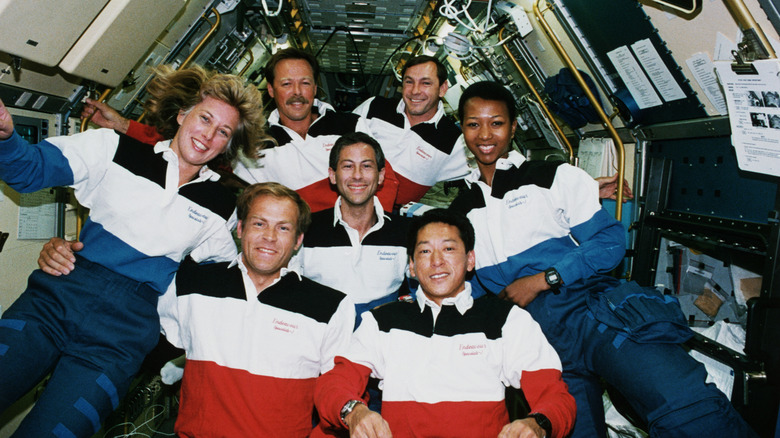
Of course, if we're already talking about making babies in space, it's natural to be curious about space sex, especially after 1992, when Jan Davis and Mark Lee became the first married couple in space. Officially, NASA still prefers not to talk about space sex and would appreciate it if we would all stop asking, something NASA's HR department also probably appreciates. But that doesn't mean space is as sex-free as a Cybertruck-owner's bedroom. A Slate article from last year explored exactly that question and came away with the conclusion that astronauts definitely go heels-to-Jesus every now and then:
"What about the rumors?" I whispered to my colleague through the din of cafeteria noise. "The astronauts have to be hooking up. If there's audio, you've heard them having sex, right? Moaning?"
She paused for a bite, then looked at her sandwich to avoid eye contact with me.
"Come on," I slapped the table. "Tell me. This isn't the Alien movie." I lowered my voice again. "In space, anyone can hear you come."
"I don't have authority to disclose that information," she said with a smirk. Then she turned away and began giggling like a maniac. She'd said it without saying it: Yes, sex happens. Yes, NASA can hear them. And no, they'll never admit it.
As for how you would do it, the lack of gravity would definitely make things more difficult (and, as the author points out, "missionary position wouldn't exist in the microgravity environment), but astronauts on the ISS do have private rooms for sleeping in that are apparently about the size of a phone booth, so it's plausible that two people could wiggle into the sleeping bag inside. However, the writer also points out that "much of the Space Station is covered in Velcro, which would be useful for doing it up against the wall." Now that's hot.