

The Weird And Dangerous Ways Drivers Stayed Warm Before Car Heaters
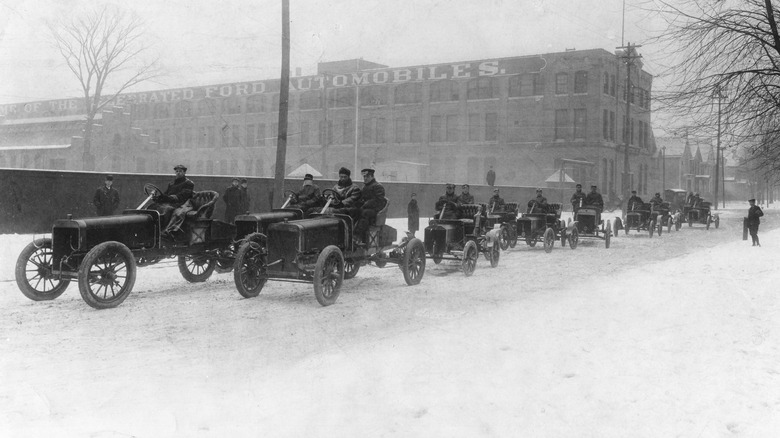
Those who reside in states that suffer under brutal winter conditions, particularly in the north, have likely had some choice words when scraping ice and snow off their cars. However, a little perspective can change your outlook, especially when you consider what early motorists had to do just to stay warm.
Because the first cars were influenced by horse-drawn carriages, something vital was missing from their design: an enclosed cabin. Before cars like General Motors' 1906 Cadillac Model H Coupe, every occupant in the car was exposed to the open air. Imagine how chilly it must've felt traveling around early 20th century Chicago in late January, which has an average low of 22 degrees Fahrenheit today. Even after automobiles began offering enclosed interiors, there was still an issue of providing heat to passengers, who initially used gas lamps (which burned coal gas containing elements like methane, hydrogen, and carbon monoxide) to generate both light and heat.
Inventive pioneers — like Margaret Wilcox, the woman who invented the car heater indirectly — laid the foundation for future car heating systems. However, several other ideas were attempted as well. Some were simple, such as using heated stones or charcoal and stowing them in the interior of the car inside drawers made of iron and asbestos. Others were more complex, attempting to route heat generated from the vehicle's muffler into the cabin. Alarm bells should be going off in your head at this point, considering these early methods of generating heat exposed motorists to fire risk, carbon monoxide poisoning, and chronic lung disease from potentially inhaling asbestos fibers. Arguably, those early threats have been replaced with a new one.
Early heaters were hazardous, but modern climate control is dangerous for a different reason
Initial heating technology for automobiles was not only basic but also presented several risks, claiming lives early on. Over the decades though, climate control systems dramatically improved, with examples like Ford's Mark I Cortina "Aeroflow" technology, launched in 1964. Recirculating air hadn't been incorporated prior, with "Aeroflow" offering vents up front bringing in fresh air, and in the rear to remove it. The '60's also saw automakers finally make heaters standard rather than add-ons.
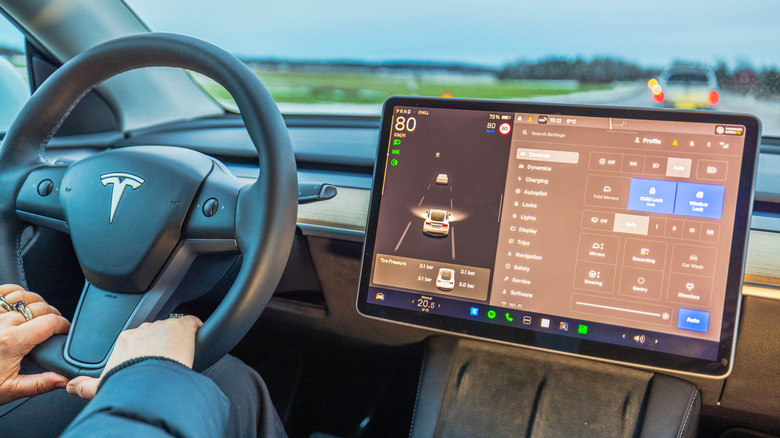
Fast forward to today, and many of the easy-to-use physical dashboard controls of decades past (such as the temperature slider) have been replaced with touchscreen menus. While modern vehicle heating systems no longer present all the dangers found in some of the first automobiles, the risk now lies in distracted driving. Many argue physical controls offer greater simplicity with their tactile function, requiring less effort — and less looking away from the road — than today's media touchscreen controls.
In a study by Auto Express, several different touchscreens were put to the test to determine which one was most distracting, citing factors like slow processing and quirky menu navigation, among others. Keep in mind that, in order to adjust the heat, one must navigate an interface similar to a smart phone, even though 33 states have a law against any physical phone use while driving and 49 states have banned texting behind the wheel. While Genesis claimed the unfortunate top spot on the list, the fact that so many automakers could appear on a test like this is an indictment of modern car design. Fortunately, some in the industry are seeing the error of their ways, with the Volkswagen CEO admitting it was a mistake to abandon buttons and other physical controls.