

Semi Trucks Have A Wild Number Of Gauges – Here's What They're For

The instrument panels in many of the cars produced today don't contain a wide variety of gauges. The ones used to monitor a car's operating systems have largely been replaced by warning lights that illuminate if something goes awry. While most cars still have gauges to indicate speed and fuel levels, many cars with the coolest gauge clusters include more to measure RPM, battery voltage, engine coolant temperature, and oil pressure.
As more vehicles employ digital gauge clusters, the need for space-consuming analog gauges is diminished. A digital display is able to show information for several systems — including engine oil temperature, transmission oil temperature, and individual tire pressures — in the space once occupied by a single non-digital gauge.
Most drivers don't seem to mind the lack of information, happily assuming everything is alright with their car until a light comes on to prove them wrong. As professional operators, semi truck drivers are faced with a different set of expectations, requiring more gauges relaying information at all times. A semi truck simply has more systems that require monitoring than what's expected from the typical automobile.
What are the gauges in a semi truck for?
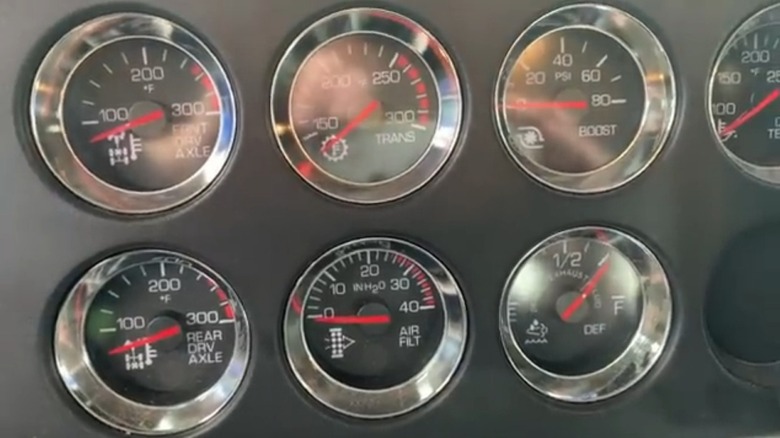
The instrument panel of most semi trucks will have some gauges that are familiar, like speedometer, odometer, and fuel gauges. Some gauges display actual values while others indicate safe and dangerous ranges.
In addition, there are other gauges that are not as common in automobiles. Temperature gauges monitor engine coolant, oil, and transmission temperatures. Meanwhile, the tachometer shows how fast the engine is spinning in revolutions per minute, and a voltmeter indicates the health of the truck's electrical system.
An air pressure gauge may be found in automobiles with air-ride suspensions, but it's not universal. In a semi truck, though, air pressure is a critical component of the braking system; low pressure could mean brake failure. Pyrometer gauges measure exhaust gas temperatures to monitor emission system health, and diesel exhaust fluid level gauges keep track of the vital fluids needed for certain trucks to run. These can both be found in diesel-powered pickups. Some semi trucks also have a boost gauge to display turbo boost pressure; this is also common to some automobiles equipped with turbo-charged engines.
Even cars with the best gauge clusters won't have as many gauges as a semi truck. Some of the ones only found in a semi can show the weight of a loaded trailer, air pressure for the trailer brakes, and temperature gauges for both rear axles of the truck. You can also find an air brake application gauge that measures how much air pressure is applied while braking. Finally, there's the air filter gauge, which monitors the pressure required to move air through the engine's filter. This helps to indicate the filter's health.