

Why Water-Filled Highway Crash Barrels Don't Freeze – Even In The Coldest Weather
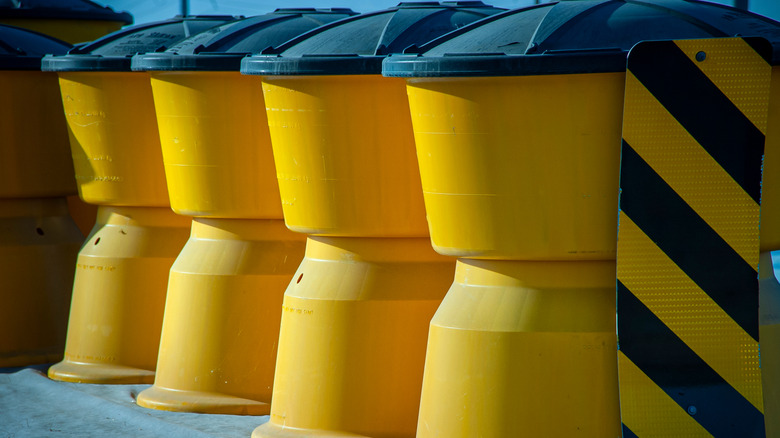
If you've ever driven down a highway, you're probably familiar with the yellow barrels that shield the ends of hard barriers and other structures from head-on collisions. You're also likely aware that those impact attenuators are filled with either sand or water. This immediately raises a question: if the barrels are filled with water, do they freeze in winter weather and other cold areas? The short answer is no. However, the full explanation begins with the fact that the liquid inside those yellow drums isn't 100% water.
Yes, the barrels would freeze if they were filled with just water. It would also cause a myriad of other issues. The crash cushions would no longer be fit for purpose. Instead of a slowed impact, vehicles would slam into a solid block of ice, which is arguably worse than anything behind the barrels. Instead, impact attenuators are filled with a mixture of water and liquid magnesium chloride. The Federal Highway Administration states that the freezing point of a 21.6% magnesium chloride solution can be as low as -28 degrees Fahrenheit. Adding it is a low-maintenance method of preventing liquids from freezing.
Racing's deadliest crash led to improved public road safety
There are obviously places where the temperature dips below -28 degrees, including at least one of the most dangerous roads in the world. In those extremely frigid conditions, sand-filled yellow barrels are the widely-adopted alternative. The sand used for those isn't just sand, either. To prevent any extra liquid inside the drum from freezing, it's a mixture of sand and salt.
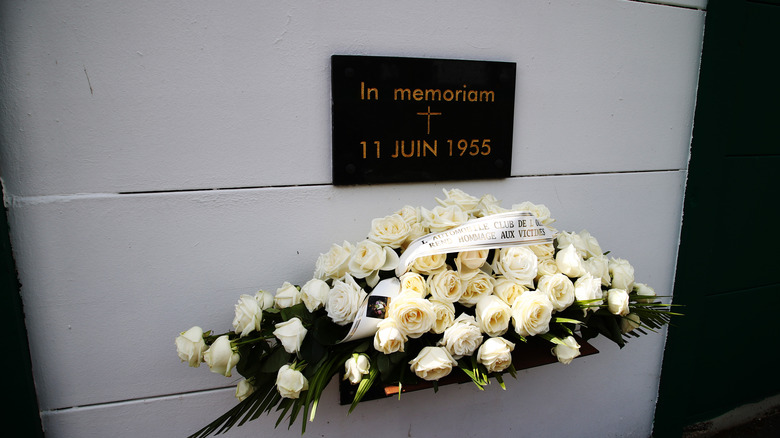
The sand-filled safety devices are often referred to as Fitch barriers, named after their inventor, John Fitch. The American factory driver for Mercedes-Benz was inspired to develop the barrier after witnessing the Le Mans disaster in 1955. While his teammate Pierre Levegh was behind the wheel, his 300 SLR crashed into the spectator area along the start-finish straight, killing Levegh and at least 82 other people. To this day, it remains the deadliest incident in racing history. Because of safety innovations like the Fitch barrier, international motorsport hasn't experienced a mass-casualty crash on the scale of the Le Mans disaster again.