

Why Honda's F22C1 Engine In The S2000 Was Unique To The US

Honda Motor Co., Ltd. has produced countless fascinating cars since its founding in 1948, and the Honda S2000 remains a high point. The regular production S2000 debuted in 1999 with the ambition of reviving the spirit of some of Honda's iconic rear-wheel-drive S series roadsters, such as the S500, S600, and S800, which were both rewarding to drive and reasonably affordable. At around $30,000, the launch car provided a low-cost alternative for Honda fans who desired a true sports car but found the NSX too expensive.
Among other things, the S2000 offered an extremely rigid X-bone monocoque frame, double-wishbone suspension, 50:50 weight distribution, rear-wheel drive, and a close-ratio six-speed manual gearbox that's reputedly slick and well-weighted. Another big part of the car's appeal still is its four-cylinder VTEC engine, which pushes out 240 horsepower (247 hp in Japanese specification) from just 2.0 liters in the initial launch AP1 Honda S2000. This imbued the sportster with an incredibly high specific output of up to 123.5 hp per liter — enough to make it the most power-dense mass-produced naturally aspirated engine at the time.
However, the S2000 did receive several updates during its ten-year production run, the most notable of which was the introduction of the larger 2.2-liter F22C1 in 2004 as the replacement for the 2.0-liter F20C. The F22C1 was offered exclusively in North America, with the 2.0-liter F20C continuing to be sold in foreign markets. This came after some U.S. buyers and reviewers criticized the F20C for lacking low-down torque, which they thought would have made the car better suited to normal driving.
A larger engine with a reduced rev limit
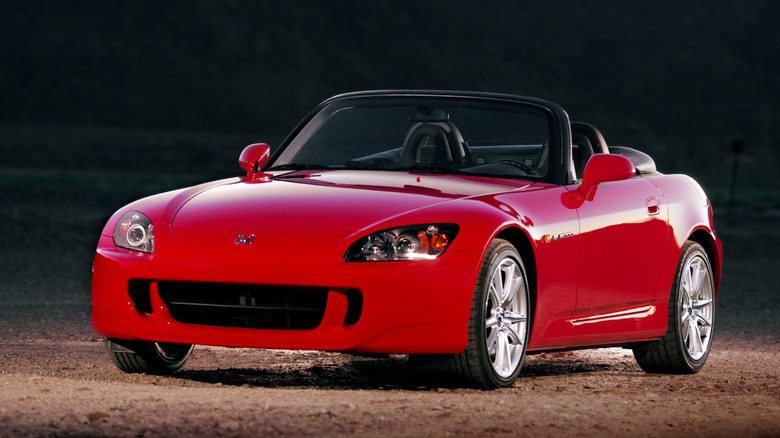
The high-revving nature of the Honda S2000's 2.0-liter F20C engine accounts for some of its charm. The four-cylinder mill boasts a whopping 8,800 rpm redline and a 9,000 rpm fuel cutoff point. But those big revs came at the expense of low-down performance. And so to offer Americans what they longed for, Honda decided to lengthen the stroke by 6.7 millimeters, thus raising displacement to 2.2 liters. The redline and fuel cutoff were also both reduced to 8,000 rpm and 8,200 rpm, respectively.
Additionally, the 2.2-liter, DOHC VTEC four-cylinder engine's extra capacity over the previous 2.0 F20C resulted in a higher torque of 162 lb-ft achieved at 6,500 rpm instead of 153 lb-ft at 7,500 rpm. While horsepower remained the same as previously, at 240 hp, peak output arrived earlier at 7800 rpm compared to 8300 rpm on the AP1-generation car. Along with the increase in displacement from the F20C, Honda reworked the valvetrain, while the six-speed transmission saw lower gear ratios for gears one through five. The new engine's design also allowed a 0.1:1 compression ratio increase from 11.0:1 to 11.1:1 in the newer 2.2-liter engine. With specs like these, it's obvious we all should have bought Honda S2000s when they were cheap.