

Inside Amsterdam's Curious World Of Microcars
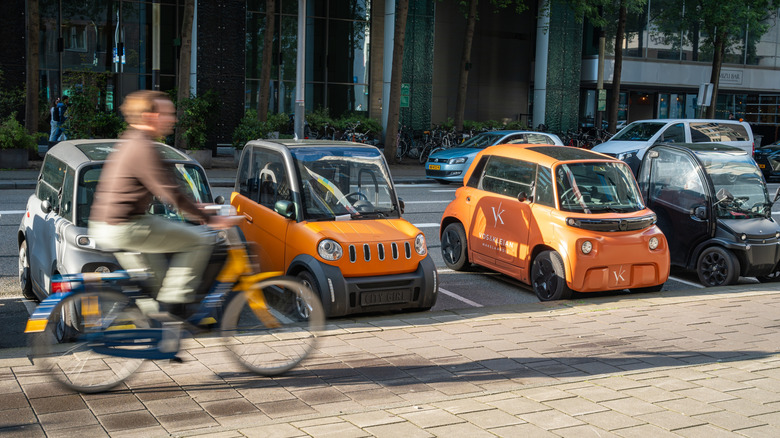
It's challenging to imagine roadways without one-ton pickups, or three-row SUVs, but they do exist ... just not in America. There are, in fact, cities across the globe with a healthy number of microcars. Americans can't access these vehicles because U.S. regulators see minicars as the enemy due to inflexible and obtuse safety regulations designed to push massive cars to consumers. Also, stateside drivers have less need for smaller vehicles as space on the road is plentiful, which can't be said for some European and Asian countries.
The Netherlands, famous for its culture of bicyclists (the number of bikes is higher than people), has transformed an ancient medieval road infrastructure into something that prioritizes human-powered vehicles over cars in many instances. So it's ironic that Amsterdam cyclists and pedestrians find themselves sharing the same space with cars, albeit tiny ones. But it's for a good reason.
The Canta is a Dutch-made microcar often seen on the streets of Amsterdam, with room enough for just two people. At only 44 inches wide, it can squeeze into places a normal-sized car could only dream about — perfect for a crowded city where cars have trouble parking. There are several different types of microcars available, but the Canta is currently the only one considered a mobility aid. Because of that, you aren't required to be licensed to use a Canta. Because the Canta isn't classified the same as a car, it can travel the countless cycling pathways and even sidewalks throughout the country. But you won't be setting any speed records, as this microcar tops out at around 28 miles per hour.
Amsterdam's microcar scene hasn't been trouble-free
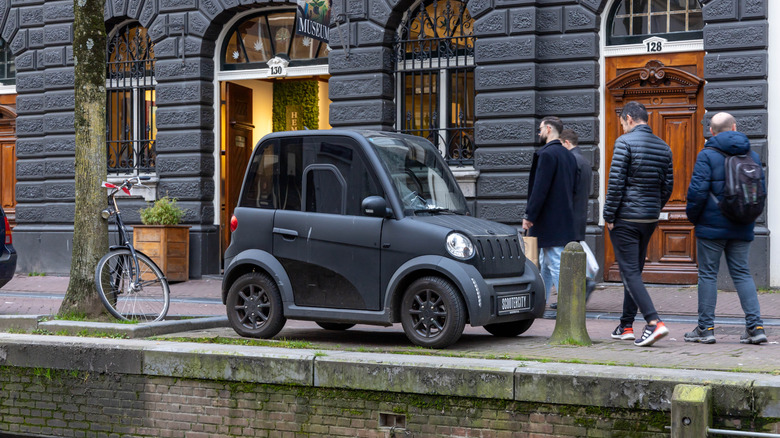
Traveling through the Netherlands' capital city, you will often see older adults behind the wheel of microcars like the Canta. Microcars are just one of the types of transportation that are more interesting in the Netherlands, since Amsterdam is the land of weird motorcycles and clog-shaped boats also. Nevertheless, a divisive trend in microcars developed, where those without mobility issues began using the microcar to gain access to its various advantages. The microcar even became the go-to choice for trendy urbanites who found it a much easier way to navigate the city.
With the entry of the Birò microcar, by an Italian manufacturer founded in 2008, the situation escalated in the Netherlands. Soon, these Birò microcars, which didn't require license plates, let alone driver's licenses, became associated with the wealthiest of residents who increasingly began blocking access for those who truly needed it. As frustration mounted, the city of Amsterdam decided that the Birò could no longer be classified as a mobility aid in 2019. This ruling required not only a driving permit and license plate, but also prevented Biròs from using bike lanes or sidewalks, completely negating its advantages.
Some issues surrounding microcars still exist, such as the Canta's only stipulations that drivers are at least 16 years old and that the Canta is covered by insurance. The truth is, some people with disabilities are woefully unqualified to operate a vehicle of any sort, let alone one that occupies the same space as pedestrians and bicyclists. It's been difficult for Dutch authorities to regulate, as there are those who would lose personal independence without their Canta microcar privileges.