

Why Ford Turned To 3D Printing For Faster Nürburgring Times
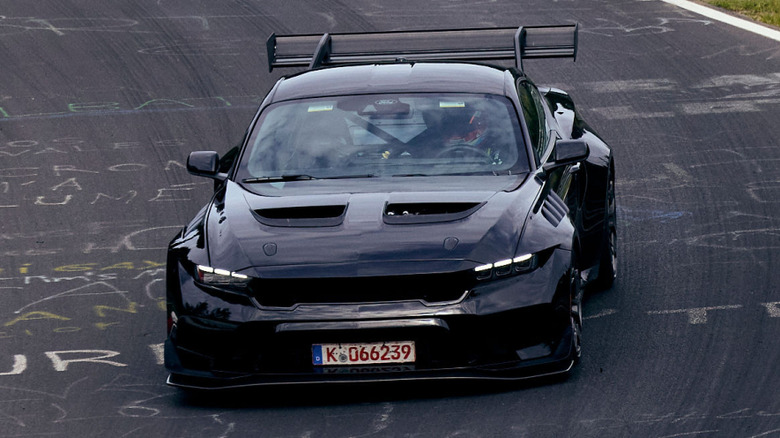
Ford treated the Nürburgring like a working garage for the Mustang GTD. From the first laps, the team leaned on 3D printing to solve late-stage problems at the track. Engineers brought additive-manufacturing gear to the pit lane, printed prototype parts between runs, fitted them, then pushed data back to Detroit for validation the same day. Why? Simple — a design freeze and tooling lead times would have killed last-minute aero ideas, so 3D printing kept development moving.
The stopwatch shows the change: a 6:57.685 full lap in August 2024 (first official sub-seven by an American brand), then 6:52.072 in April 2025, both by Dirk Müller on the 12.94-mile (20.832-km) standard loop. Central to that approach were small 3D-printed aero pieces placed around the vents on the front end of the car and nicknamed hood flicks, which added front downforce without a drag penalty and set up the gains seen in Ford's onboard and ghost-lap comparisons.
Underneath, the GTD runs a supercharged 5.2-liter V8 rated at 815 horsepower and a rear-mounted eight-speed dual-clutch transaxle on Michelin Pilot Sport Cup 2 R tires. Those fundamentals were set before the Nürburgring push, what changed trackside were small aero surfaces the team could iterate quickly without waiting on tooling. Here's how Ford's Advanced Manufacturing Center lets engineers design, print, and test parts within a single test window.
The 3D-printed hood flicks that stuck
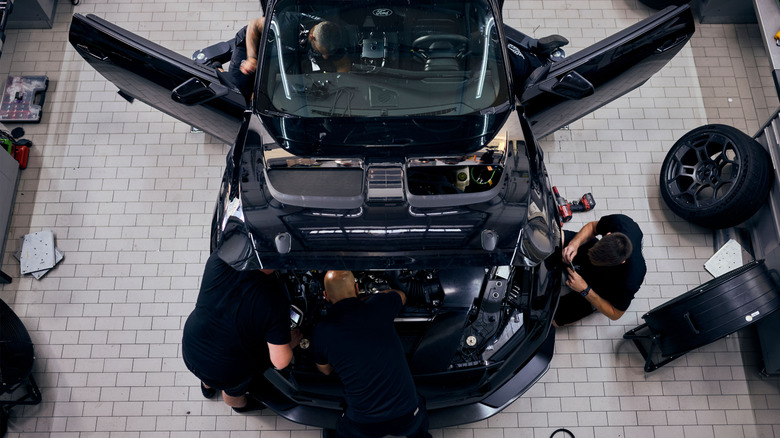
In an interview with The Drive, chief program engineer Greg Goodall has likened hood flicks to "little raised ski slopes," and said vehicle-dynamics specialist Steve Thompson flagged the idea from the Nordschleife after testing 3D-printed samples. Goodall and design manager Anthony Colard's groups turned that field test into a production shape in roughly a week or two, cycling through seven or eight iterations and about 20 drag-coefficient checks before sign-off.
To build the hood flicks specifically, the team moved from CFD to printed pieces that added front balance in high-speed sections within the same test window, then confirmed the shape in the wind tunnel back in Michigan. That print-fit-run loop was to keep the pieces drag-neutral while buying stability in fast sections. While the parts arrived late in the program, Goodall made it clear breaking seven minutes would have been "very tight" without them.
Multimatic's semi-active Adaptive Spool Valve dampers give the GTD a dual ride height, and Track mode drops the car about 1.6 inches. This meant the added front balance from the flicks works with a lower center of gravity at speed. Out back, the swan-neck rear wing mounts to the C-pillars and shares DNA with the exclusive Mustang GT3 setup, while the trunk space houses a transaxle cooling pack. This packaging complements the front-aero changes without adding drag.
Where 6:52.072 lands now
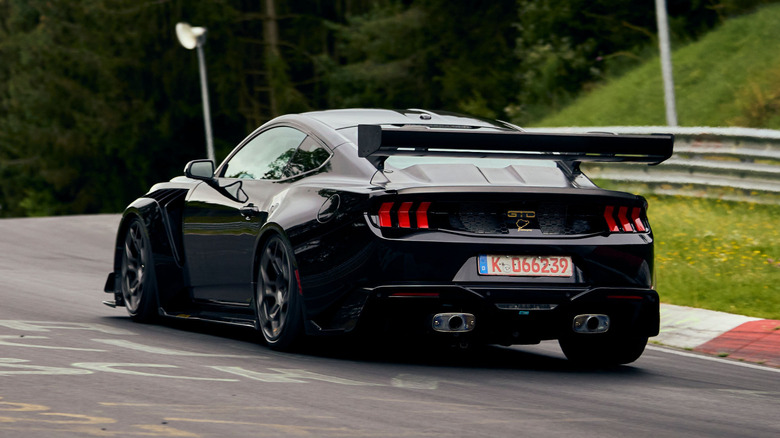
On the full-lap protocol, 6:52.072 places the GTD among the quickest production cars ever to lap the Nordschleife, behind the Porsche 911 GT3 RS at 6:49.328 (same 20.832-km full lap) and quicker than Ferrari's 296 GTB reference time of 6:58.7 set by Sport Auto on its 20.6-km Supertest lap. The Ferrari run was driven by Sport Auto's Christian Gebhardt, underscoring the protocol difference with recent manufacturer records.
Ford says the GTD program isn't done, and it has now consolidated its track focused work under the revived Ford Racing banner as a part of a broader plan to tighten the flow of motorsport methods into road cars. Leadership says that rebrand is about faster tech transfer from competition to production, with the GTD serving as a live example.
Beyond GTD, Ford is expanding additive manufacturing across programs, printing complex components like cooling plates for its forthcoming Red Bull F1 power unit and feeding the same culture that showed up at Nürburgring. Ford has also indicated it will continue running the GTD at Nürburgring as development evolves under the Ford Racing umbrella.