

How Audi Used Old Tech And New Thinking To Make Its Dakar Champion
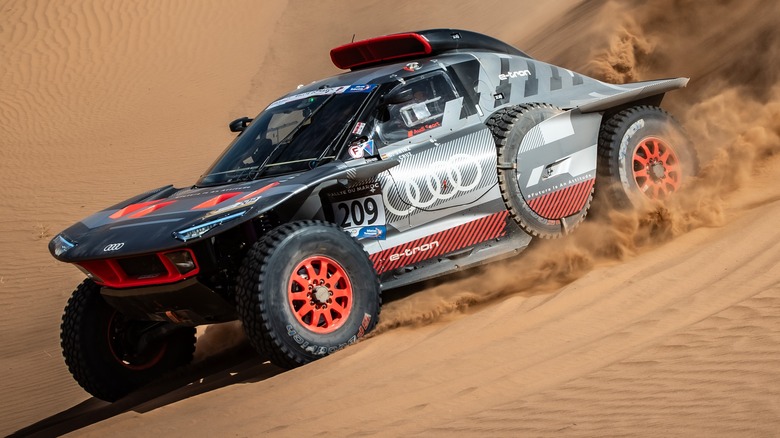
There's no race on Earth quite like the Dakar Rally. Since the first 6,200-mile contest in 1979, from Paris to Senegal, riders and drivers from all walks of life have crossed Africa, South America, and now Saudi Arabia to tackle one of the planet's most challenging rallies. A race as unusual as the Dakar has led to one-of-a-kind trucks and cars made to tackle days on end in the desert, from the iconic, restoration-worthy Porsche 959 used in the 1986 race to purpose-built Dakar beasts like Prodrive's Huntee, which now has a street-legal version. Sometimes you have to get weird to win Dakar.
Take Audi, for instance. The German marque didn't just get its first Dakar victory in the 2024 edition of the legendary race, but entered history as the first to do so on all-electric power. But despite having an entire library of SUVs in its arsenal, Audi elected to start from scratch and created a monster of mashed-up motorsports mechanics. Meet the RS Q e-tron.
The four rings go Frankenstein
For many in the motorsports world, seeing Audi leave Formula E at the end of 2021 was beyond bizarre. Winner of the first E-Prix in Beijing in 2014, and taking the constructor title in season four, it quickly became one of the biggest names in the young championship. But ultimately, the program achieved its goal of developing its electric performance brand, and wanted to move on to proving electric power's pace and reliability in one of the globe's most challenging races. The goal was set: to become the first manufacturer to take Dakar on electrons.
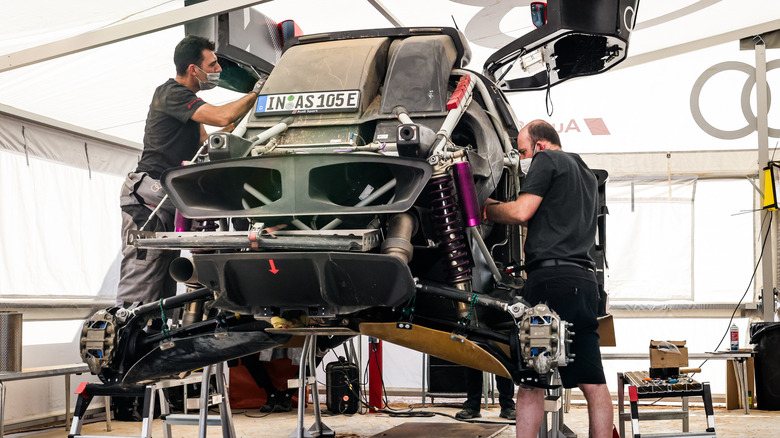
Fortunately for Audi, it already had the perfect parts for its challenger. At its heart, two Audi MGU05 engines were pulled from Formula E machines and placed on each axle, sending 383 horsepower to the beast's four wheels. That's phenomenal for instant torque and low-end performance, but Dakar's longer stages can stretch out to over 600 miles — beyond what the e-tron's 52 kWh battery could push to. The solution? Rip a gas-powered Audi TFSI engine out of a DTM-series race car and mate it to a generator, converting the gas to electricity. The RS Q e-tron was born.
When the battery got low, the TFSI would kick on and sit around 5,000 rpm to recharge it. This made for one of the weirdest soundtracks in the desert, with the droning straight four sounding almost like it had a continuously variable transmission. Most importantly, it kept the e-tron running and in contention for winning the world's toughest rallies.
Taking on Dakar
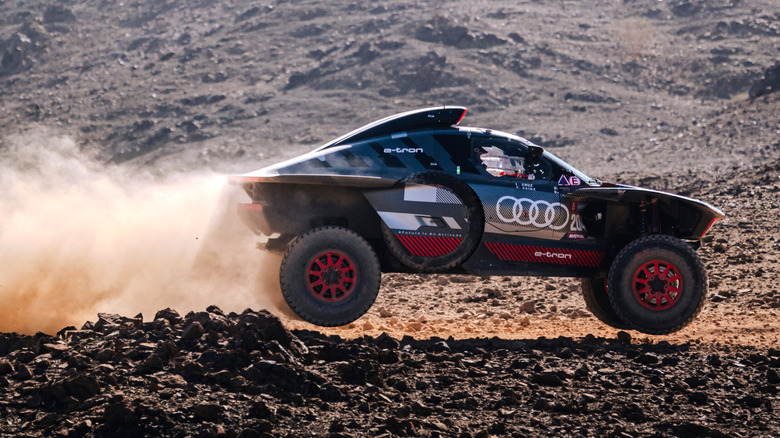
To drive the e-tron, Audi assembled a murderers' row of rally raid drivers, headlined by two-time World Rally Championship winner and three-time Dakar champ Carlos Sainz. He'd be alongside Mr. Dakar himself, the rally's winningest driver, Stephane Peterhansel, as well as long-tenured Audi Factory pilot Mattias Ekstrom.
From the team's first Dakar in 2022, the speed was there, with each driver bringing the team its first stage wins. Ekstrom's ninth place was the team's top result on debut, but optimism remained high for the following year, with the upgraded E2 version on the way with its lighter, lower-drag body and more efficient energy management. But Audi couldn't uncork the pace in '23. It was fastest in the prologue, a handful of punctures hobbled all three cars. While trying to retake the lead, Sainz and Peterhansel suffered violent crashes, forcing them out on Stage 6 and Stage 9, respectively. With one e-tron left standing, only Ekstrom would bring it home in 14th place.
Third time was the charm, however. In 2024, Sainz and co-driver Lucas Cruz gave Dakar the Audi dominance the brand had been looking for, finishing a stunning 80 minutes ahead of Guillaume De Mevius' Toyota Hilux. Sainz earned his fourth Dakar victory, and Audi finally got its win in the desert.
Then, with the four rings' Formula 1 entry just a couple of years away and the team's main goal being accomplished, Audi quickly pulled the plug on the program after its victory — a storybook ending to one of the most brief, yet brilliant cars and teams to compete in the Dakar.