

Why Did Car Makers Switch To Water-Based Paint?
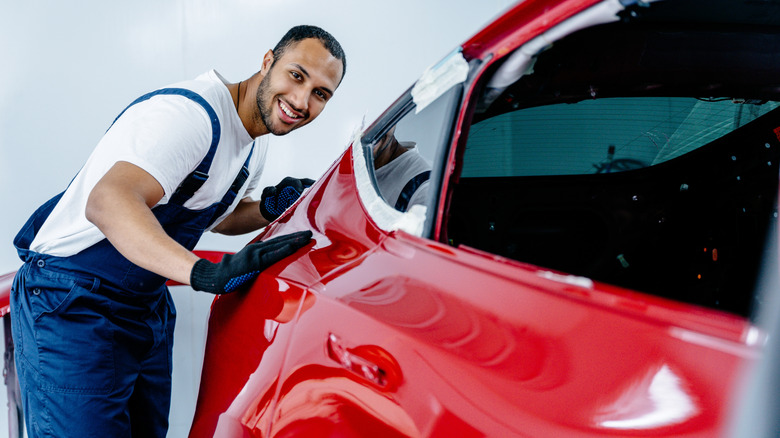
Automotive paint technology has come a long way since Henry Ford famously stated, "The customer can get the Model T painted in any color he wants, so long as it's black!" This was the only option in 1908, as it was the most durable and least expensive choice at the time. Fast forward to today, and automakers are doing crazy things with paint — like how Nissan wants to cool your car with fancy paint that uses a variety of synthetic materials that refuse to absorb heat. However, for decades, automakers relied on basic solvent-based paints, but these proved to have some drawbacks.
For one, the use of these products resulted in the release of toxic emissions into the atmosphere. In the 1980's, the EPA started cracking down on volatile organic compounds (VOC) and placed restrictions on auto factories in terms of how much solvent could be used. Fortunately, introducing water into the basecoat process not only lowered VOCs, but also gave cars a metallic look that many found appealing.
Some in the industry feel that waterborne paint provides more vivid and striking colors, but its advantages don't end there. Some water-based paints utilize more solid content, meaning it doesn't take as many coats to cover the car, making the process more efficient. Harry Christman, the DuPont Refinish brand manager, spoke to SEMA (Specialty Equipment Market Association), explaining, "Rather than having to lay down a coat of paint, let it flash, then lay down another one, let it flash—and, depending on what you're working with, lay down four, five, six coats—with Cromax Pro, you cover in one and a half coats."
Things to know about water-based automotive paint
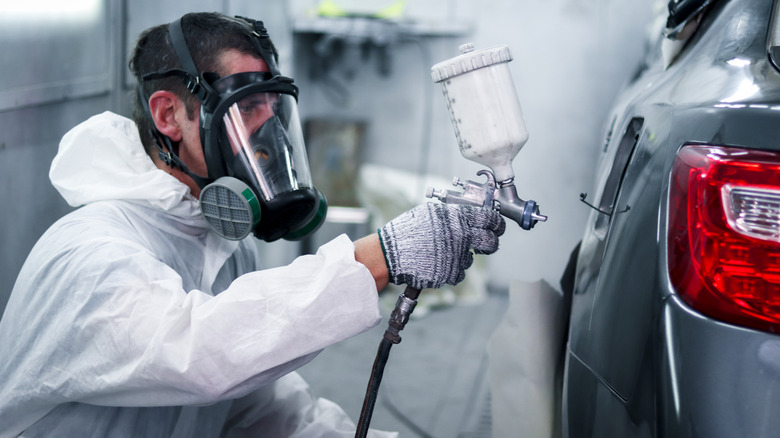
Waterborne paint is often misunderstood, as the term can give the impression that water completely replaced solvents throughout the process. On the contrary, sealers and clear coats are still based on solvents. The basecoat, which applies the color, is the only water-based part of the application. It's worth noting that the color may look strange for a short while after it's applied, which can cause some newbies to go into a panic. Fortunately, as the waterborne paint dries, its correct hue begins to shine through, often in more vibrant tones than old-fashioned solvent blends. Speaking of bright paint jobs, sometimes it's worth getting a little crazy, as the paint colors that decrease a car's resale value the most are not the ones you'd think.
As you may imagine, water-based paint is more susceptible to humidity than traditional products with a solvent foundation. This means that, depending on where you reside, the painting process could be a bit different. In the American southwest, where humidity levels can be very low, waterborne paint will dry much faster, than somewhere like Louisiana, which averages between 88% and 91% relative humidity levels in the morning. The issue is, for the best outcome, you don't want water-based paint to dry too quickly. So, some paint manufacturer's have started to create different versions of their products to account for the varying levels of humidity around the country. That means a shop in the south is going to use a different mix than one in Nevada.