

The First Air Force One Had A Custom-Built Elevator For FDR's Wheelchair
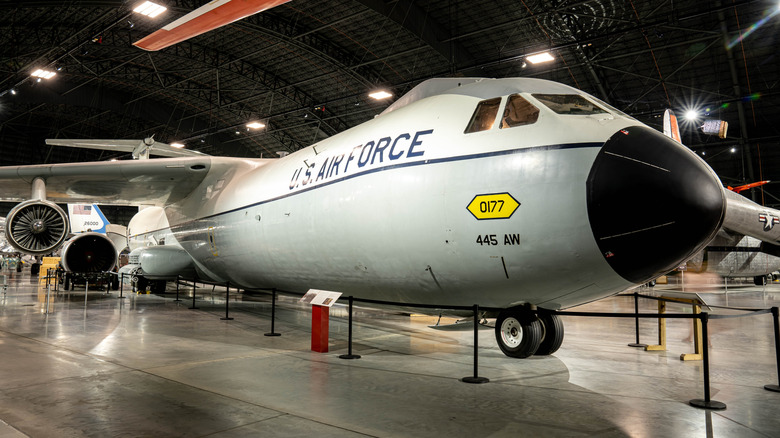
The Douglas VC-54C Skymaster, nicknamed the "Sacred Cow," was the first airplane built for a U.S. president. Before this, presidents either avoided international travel or used commercial planes, as Franklin D. Roosevelt did in 1943 when he flew to Casablanca on a Boeing 314 Clipper. That flight highlighted the risks of long voyages during wartime and pushed military leaders to develop a safer, dedicated option. The Skymaster was based on the DC-4 but heavily modified for Roosevelt. The most notable change was a battery-powered elevator mounted at the rear of the plane. Roosevelt, who used a wheelchair because polio had left him partly paralyzed, needed a dignified and practical way to board. Without the elevator, he would have had to be lifted by aides or use cumbersome ramps.
Inside, the Sacred Cow included a private lavatory, a fold-down bed, a bulletproof window, and a conference room with a desk. A galley with one of the earliest aircraft refrigerators made meal service more efficient. To extend its range, auxiliary fuel tanks were installed inside the cabin, reducing space but enabling the plane to cover 4,000 miles without refueling. While it lacked pressurization, forcing passengers to use oxygen masks at altitude, the Sacred Cow gave the president secure, customized air travel for the first time. This marked the beginning of a new era where the office of the presidency demanded dedicated aircraft.
Roosevelt, Truman, and the Sacred Cow in action
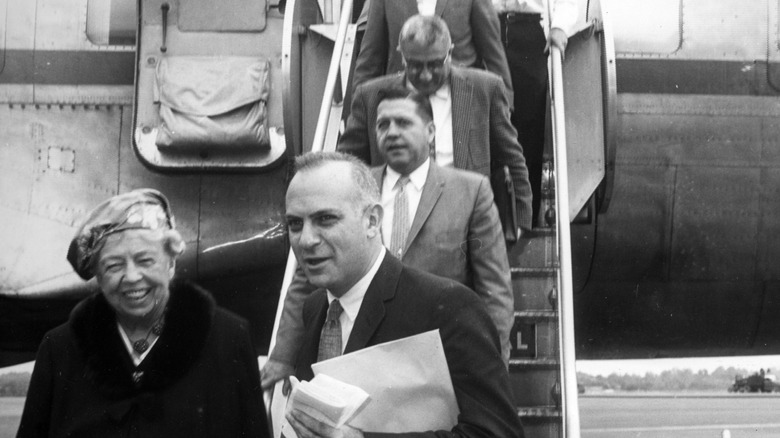
Roosevelt used the Sacred Cow only once, for his February 1945 trip to the Yalta Conference in Crimea. He traveled there to meet Winston Churchill and Joseph Stalin in what would be his final international summit before his death in April. Despite its limited use by Roosevelt, the aircraft quickly became associated with the expanding role of the presidency in global affairs.
When Harry S. Truman (whom General Motors had a grudge against) succeeded Roosevelt, the Sacred Cow remained in service. Truman used it frequently and even turned it into a stage for a defining moment in American military history. On July 26, 1947, Truman signed the National Security Act aboard the Sacred Cow, creating the CIA, the National Military Establishment (later renamed the Department of Defense), and the U.S. Air Force as an independent service branch. So the Sacred Cow is often called the birthplace of the Air Force.
The aircraft could hold 15 passengers in addition to its seven-person crew, giving it enough capacity for key advisers but still cramped compared to later Air Force One jets. Later in 1947, Truman replaced the Skymaster with the larger VC-118, the Independence, a DC-6 decorated with an eagle motif. The Independence was pressurized, had more powerful engines, and could hold 24 passengers. Still, the Sacred Cow's role in both wartime diplomacy and the creation of the Air Force makes it unique. It showed how aircraft could be extensions of the Oval Office.
From accessibility to legacy in Air Force One
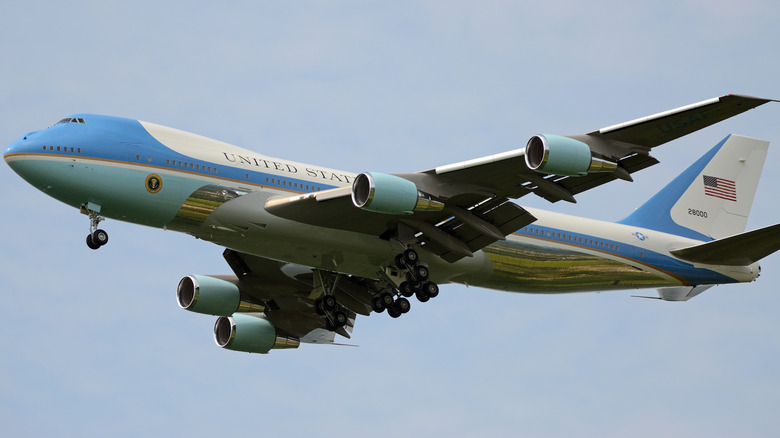
The Sacred Cow was retired in 1961. Later restored, it's now on display at the National Museum of the U.S. Air Force in Dayton, Ohio, alongside other historic presidential planes like Truman's Independence and Dwight D. Eisenhower's Columbine III. Its legacy is tied to accessibility as much as politics: The custom-built elevator acknowledged the president's disability at a time when public discussion of Roosevelt's paralysis was limited. In many ways, it set a precedent: Air Force One should adapt to the president, not the other way around. That principle carried forward as aircraft became more advanced, from Eisenhower's Lockheed Constellations to John F. Kennedy's Boeing 707 with its iconic blue-and-white livery, designed by Raymond Loewy.
Today's VC-25A 747s, and the upcoming VC-25Bs based on the 747-8 (which President Donald Trump is desperate to fly on), are far larger and infinitely more capable, with secure communications, in-flight refueling, and room for over 70 passengers. Yet despite their size and sophistication, the challenge of accessibility remains. Advocates argue that the next generation of Air Force One (which could be supersonic) should expand on what the Sacred Cow started by including modern wheelchair securement systems and universal design features.
Commercial airlines still lag in accommodating disabled passengers, but Air Force One has the potential to lead by example. The Sacred Cow's elevator was a simple yet powerful innovation, and its spirit continues to shape the conversation around inclusivity and the responsibilities of presidential air travel.