

9 Hot Rod Styles Every Gearhead Should Know
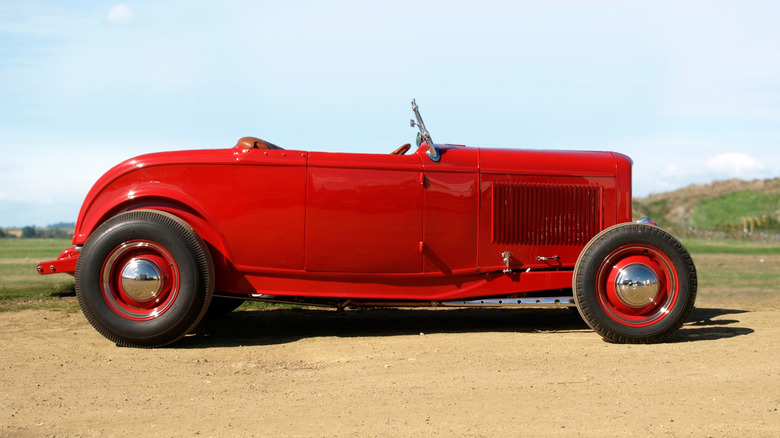
Hot rodding is an iconically American phenomenon. Hot Rod magazine defines a hot rod as "an early American car that has been modified for improved looks and performance." Hagerty adds that the term "typically refers to older classic American cars that are hopped up with large engines and modified for weight reduction." Yet these definitions barely scratch the surface of how diverse hot rods can be. They reflect the resourcefulness of shade-tree mechanics, a desire for individuality, and oftentimes a rebellious spirit.
The origins of hot rodding can be traced back to the "gow jobs" of the pre-World War II era, which were often built on the Ford Model T and Model A, had their engines modified, and had fenders and other body parts removed. After the war, the Ford Flathead V8 became an icon of hot rod history as GIs, sailors, and airmen returned home with newly acquired mechanical skills. Since then, hot rod culture has taken a bewildering variety of forms, including the thing everyone needs: a supercharged wheelbarrow.
More conventionally, hot rod culture has spawned a huge vocabulary to describe the styles of cars and the hardware and design features that make them unique. We recently put together a list of common hot rodder terms like blower, double pumper, and Frenching. But there's an almost endless variety of body styles to learn about, too. The following is a list of widely agreed-upon hot rod styles that gearheads should know.
Street Rod
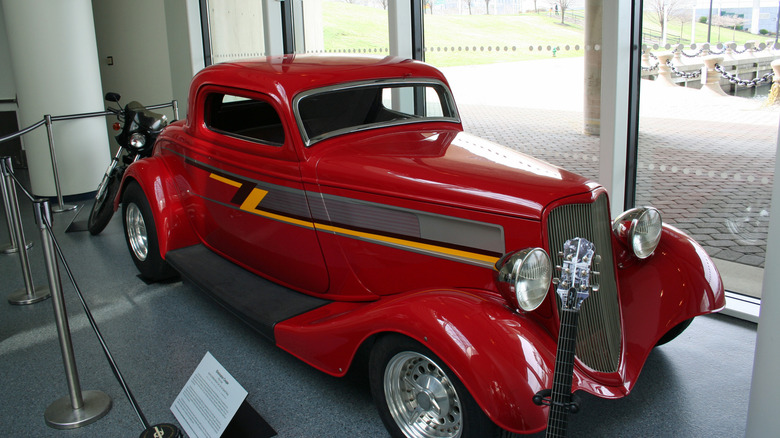
Like many terms in hot rodding, there's a general consensus with some disagreement regarding the finer details. The traditional definition was a pre-1949 classic car modified for modern standards of reliability and safety. Nowadays, the National Street Rod Association (NSRA) says its event participation is "open to vehicles thirty years old and older and over time has mirrored the ever-changing world of street rodding." The organization allows not just "timeless pre-1949 street rods and hot rods" but also custom and retro cars right up through the 1990s.
Jalopnik has previously covered the difference between street rods, rat rods, and hot rods, noting that street rods use modern crate motors. Street Muscle Magazine emphasizes the shift from hot rods, which were primarily built for racing, to street rods, which "were meant to be driven more than a quarter mile at a time." Their definition includes modern running gear, "pristine paint jobs, and cushy interiors."
A famous example of a street rod is ZZ Top's 1933 Ford called the Eliminator, which is pictured above. Don Thelan built this striking car from a three-window coupe, while Kenny Youngblood supplied the graphics emblazoned on its sides, complete with a stylized double-Z. The car appeared on the cover of the band's "Eliminator" album and in four of its music videos, proving so popular that band member Billy Gibbons commissioned California Street Rods to build a duplicate for touring.
Rat Rod
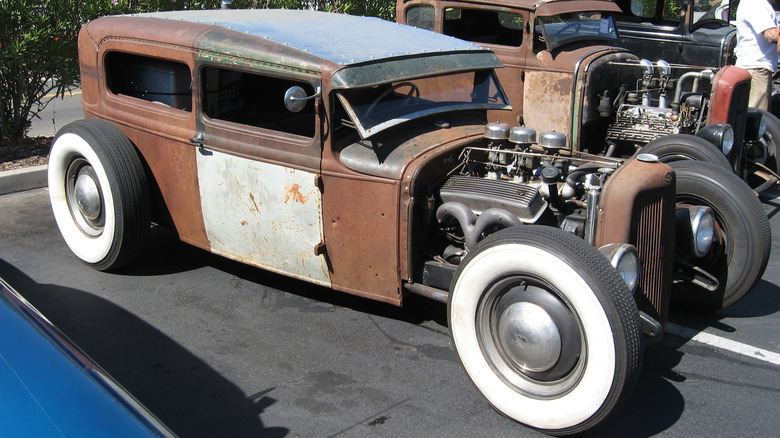
Like many hot rodding terms, the boundaries of the rat rod category are fuzzy and fluid. Surprisingly, JD Power – better known for reliability surveys — took on the question of what a rat rod is. According to them, "ratty" has long been a synonym for "shabby" and was originally applied to motorcycles with slapdash modifications. They credit Hot Rod magazine's Gray Baskerville with transferring that imagery to cars and inventing the term "rat rod" in the 1990s.
Hot Rod magazine agreed in an article from 2020, crediting the late Mr. Baskerville with the term and going on to define some of a rat rod's characteristics. First, they pinpointed the origin of the genre to 25 years earlier, roughly about 1995, describing it as a reaction to the slick, high-tech hot rods of the era. Rat rodders sought to go back to the early days of hot rodding, building "budget-limited home-based" cars with "worn paint or a primered finish." They look like cars rescued from a junkyard and brought back to life, with few cosmetic enhancements.
Rat rod builders aren't known for giving a high priority to safety. Aside from their sometimes questionable engineering and rusty, untrimmed body panels that make it a good idea to update your tetanus shots before driving them, there's often an in-your-face rebellion against the nannyism of the modern automotive world. This can include features like saw blades used as sun visors, sawed-off shotguns used as gearshifts, and other modifications that would make an NHTSA bureaucrat weep. Rat rodders sometimes take "ride or die" to its extreme.
Track Roadster
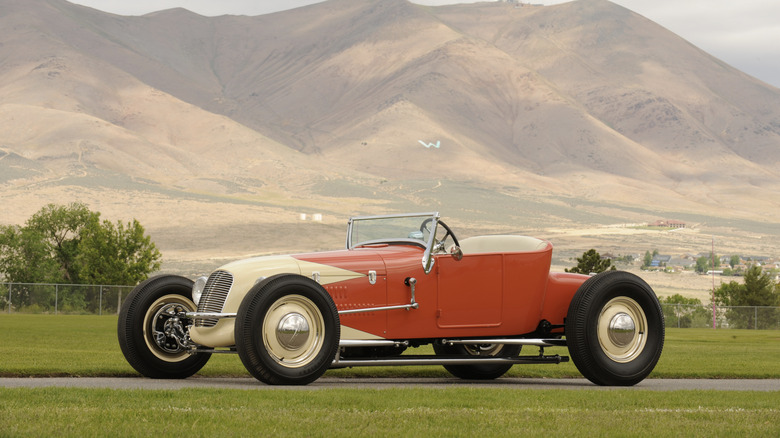
Track roadsters are a fun category, a group of cars designed to go fast, with almost every feature serving that purpose. Hagerty says, "track roadsters are inspired by dirt track sprint cars and dry lake-bed racers, and thus are streamlined." To achieve this aerodynamic form, they often feature the downward-curving deck from a Model T roadster, a narrow body, and a rounded nose. If built strictly for race tracks or lake beds, they don't even need street-legal features like headlights.
Track roadsters, also called track T roadsters, have been around for quite a while, with one having graced the cover of the first issue of Hot Rod magazine way back in 1948. They can be based on vintage Model T frames or built from kits supplied by companies like Speedway Motors. Either way, they can be outfitted with modern running gear, such as an aluminum version of the Flathead V8.
A track roadster appears in the Smithsonian's National Museum of American History. This car was built in 1948 by Dick Fraizer, Floyd Johnson, and Hack Winniger, and it illustrates the improvisational engineering of early hot rods with a Ford Model T body on a Chevy chassis, all powered by a Ford V8. A 1927 Model T "track-nosed" roadster built by Jack Thompson in 1954 recently sold at Sotheby's for $145,600.
T-Bucket
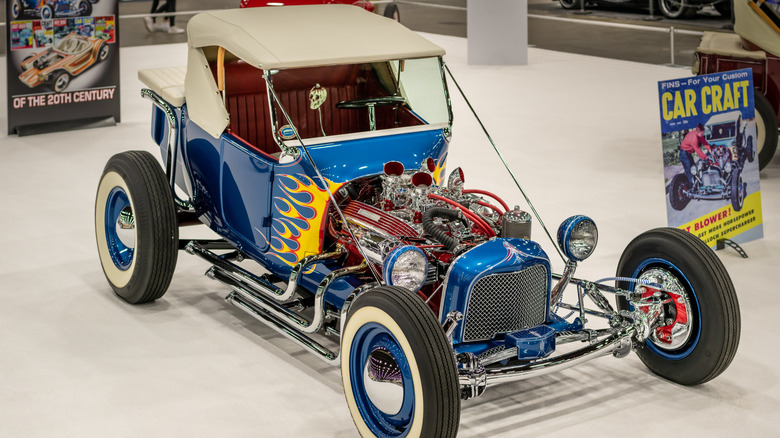
T-buckets are Model T-based roadsters that played a crucial role in the evolution of hot rod culture. Ford built millions of Model Ts between 1908 and 1927, which meant three things: there were plenty of donor cars, they were cheap, and people wanted something distinct from all the other Model Ts on the block. The first kits for customizing them appeared all the way back in the 1920s. Of course, there was also the do-it-yourself option, enthusiastically seized upon by young speed freaks, giving birth to the term "hot rod."
T-buckets remained their own distinct niche within the hot rodding world for decades, with certain common characteristics. Body panels such as hoods and fenders were ditched to save weight, creating the T-bucket's iconic stripped-down, exposed-engine look. Engines could be upgraded or replaced entirely with Flathead V8s. By the 1950s, a new T-bucket style appeared called the California rake, with a low front end and a high rear end, often with tilted body panels to match the angle of the rake.
Other features of T-buckets include a two-person bench seat, a generally roofless passenger compartment (with some exceptions), and wild paint jobs ranging from flames to elaborate murals. The car that's often credited with popularizing T-buckets was Norm Grabowski's Kookie T (pictured above), which he built in the early-to-mid 1950s from a Model A roadster, a Model T, and a shortened Model A pickup bed. It appeared in the April 1957 edition of LIFE magazine and then in the TV series "77 Sunset Strip" the following year.
Lowboy
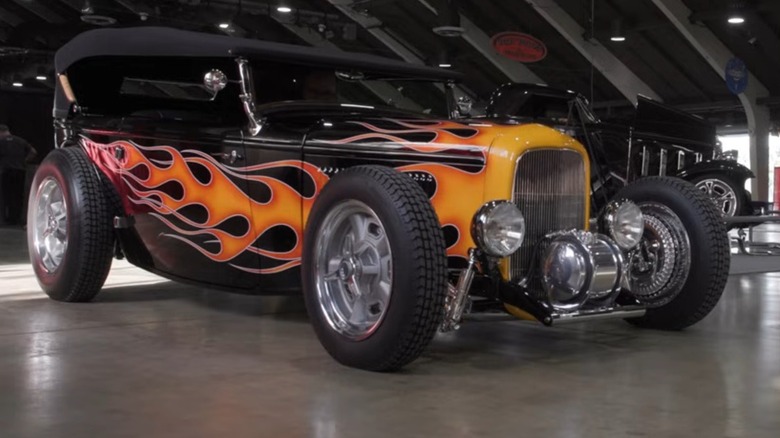
Hagerty defines a lowboy as a "fenderless hot rod that's channeled over the frame." That will require some explanation, but first let's clarify that a lowboy is different from a lowrider, which is a style of car with a greatly lowered suspension and typically adorned with custom body work and eye-catching paint jobs. By contrast, a lowboy achieves its aggressively lowered stance by lowering the body over the frame, which is what "channeled" means.
The goal of channeling is lower wind resistance. Early hot rodders discovered that this was a great way to wring extra speed out of the tall, boxy cars of the 1920s and 1930s. The process sounds simple, in theory: the body of one of these older cars normally rests on the frame rails, so if you cut out the floor, the rest of the body can be lowered down over the rails and welded in place at its new height. Since you're ditching the fenders, there's no need to figure out how to make them fit the new configuration.
While channeling started out as a low-tech way to cheat the wind, in the right hands, it can produce an absolutely stunning car. The winner of the 2024 Grand National Roadster Show was a 1932 Ford Lowboy Phaeton owned by Beth Myers. This gleaming black and flame-painted beauty was built by Roy Brizio Street Rods by channeling the body over the frame by six inches. The body was customized, and the hood covers a 400-horsepower, 347-cubic-inch Ford V8.
Highboy
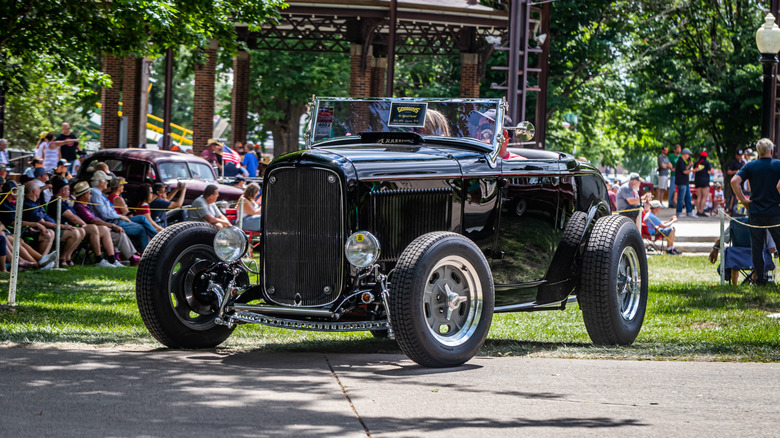
The term "highboy" pretty obviously stands in opposition to the term "lowboy," but given that both classes of hot rods can look pretty similar to outsiders, it's worth delving deeper into the differences. Like many movements in hot rodding, the highboy trend had its origins in Southern California in the 1940s, where roadsters in particular were favored because of the region's sunny climate. This meant roofs could be removed or converted to vestigial canvas tops to save weight. Hot rodders then went the extra distance by removing fenders and running boards, too.
This stripped-down look was shared in common with lowboys, but highboys weren't channeled for a lower stance. Their bodies sat on top of the frames, just as they came from the factories. As a result, a Hot Rod magazine writer named "T" Texas Smith coined the highboy moniker because the fenderless cars with no running boards looked high off the ground compared to channeled lowboys. Ford Roadsters from 1928, 1929, and 1932 were popular for highboy conversions, but three- and five-window coupes, cabriolets, and other body styles have also become highboys.
An iconic highboy hot rod is Bob McGee's red 1932 "Deuce" roadster, which became so famous that its profile became the logo for the L.A. Roadsters club. While the Deuce is a highboy in terms of its body construction, it sports a lowered suspension and several other features that were innovative when McGee built the car in 1948. It went on to to achieve pop-culture fame, appearing in numerous TV shows.
Gasser
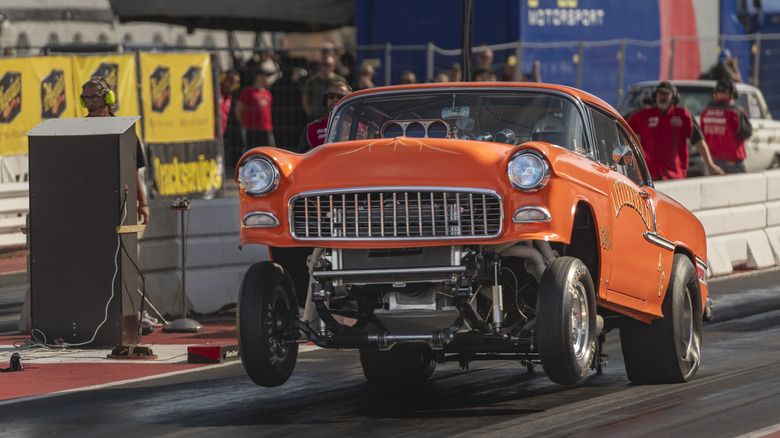
Gassers were built for organized drag racing in the 1960s and earned their name by virtue of running on gasoline, rather than the nitromethane fuel used by other dragsters. Gassers were often built from cars that you might not typically associate with hot rodding, like '55 Chevys, Willys coupes and pickup trucks, and the Henry J., a compact car built by the Kaiser-Frazer Corporation. The 1949 to 1953 Ford Anglia, another compact car, was also popular, with one example featuring a fuel-injected, 5.8-liter Chevy small-block V8 under the hood.
Gassers often feature an odd stance with a high front end. This isn't a fashion choice, unlike the similar-looking Carolina squat, which is one of the car mods that we think should be banned immediately. Instead, the high front ends of Gassers were functional. The full reason for this involves an annoying amount of complicated physics, but the short answer is that it helped to push the car's center of gravity higher and further back, making it more likely to pop a wheelie. This puts more weight on the rear slicks for better traction at launch.
Gassers could be blisteringly fast, especially considering the improvisational and home-built nature of many of the cars. They frequently ran quarter-miles in not much more than nine seconds, hitting 150 mph. Drag racing fans would convert their cars to the Gasser look, raising the front suspension, deleting "unnecessary" bodywork like bumpers, and often adding scoops protruding through the hood, although the latter wasn't generally seen on the track. Nowadays, nearly any lightweight car can be a Gasser, including Corvettes and Mustangs.
Pro Street
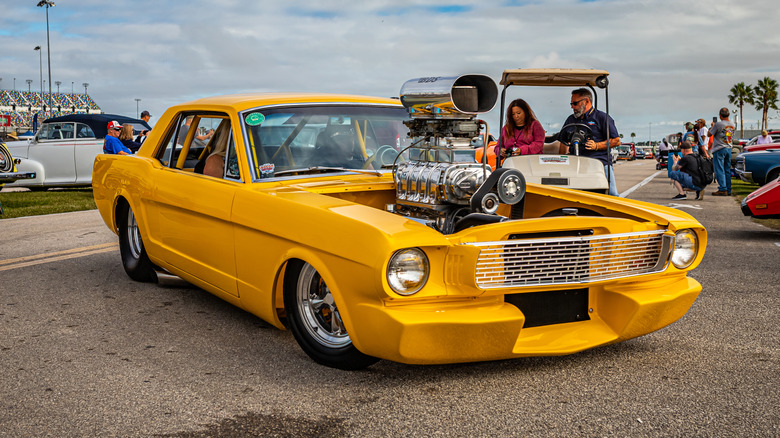
At first glance, the Pro Street category of hot rodding seems to have been born from dragstrips, just like Gassers, but in this case, it's more aspirational since these cars never competed professionally. Instead, they emulate the aesthetics of the Pro Stock class of drag racing from the 1970s. It's not that these cars aren't fast, but since they're pretty impractical for regular street driving, they generally leave the garage only to attend car shows.
Not that there's anything wrong with that! Many of these are gorgeous machines, with drag racing rear suspensions, massive rear tires, eye-catching paint jobs, and superchargers towering up through the hoods. Many of them even take the drag-racing look so far that they feature roll cages, wheelie bars, and parachutes.
Nearly any car can be converted to a Pro Street hot rod if the builder is imaginative enough. One famous Pro Street machine is a 1982 Pontiac J2000 converted by Rick Dobbertin, proving that a car need hardly be born with high-performance genes to be genetically engineered into a spectacular monster –- in this case, a monster with 33x23x15 rear tires and a 350 small-block with dual turbos and dual superchargers.
Deuce
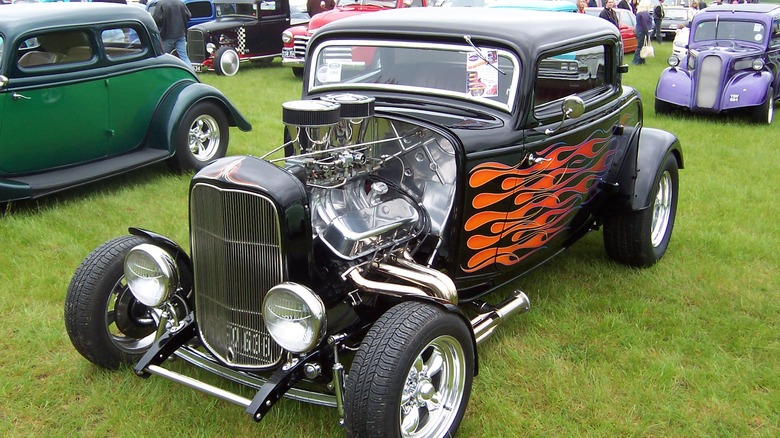
"Revved up like a deuce, another runner in the night, blinded by the light." These lines, from Manfred Mann's Earth Band's version of Bruce Springsteen's "Blinded by the Light," have baffled generations of non-car fans. Well, we're here to tell everyone who doesn't already know this: a "deuce" is a hot rod — apparently, one whose headlights are blinding a jogger.
There are two meanings for "deuce" in the hot-rodding world: a 1932 Ford or a two-barrel carb. For our purposes here, it's a Ford. The '32 Ford became an iconic hot rod thanks to a number of mechanical, structural, and aesthetic factors. For instance, its steel-reinforced body was vastly more durable than most earlier car bodies, which were framed with wood and covered with metal panels. This meant the Ford survived long enough for hot rodders to get older ones cheap, and they could handle the stresses of high-performance driving.
The '32 Ford also came available with the Flathead V8, an engine that was produced in sufficient volume for hot rodders to get used ones cheaply a few years down the line. After World War II, Chevy small-block V8s became a common engine choice for Deuces. Both roadster and coupe versions of the Deuce could be made into hot rods, with the unexpected aesthetic benefit that removing the fenders and running boards created a sleek and aggressive look, thanks to the core body's clean lines.